
Experience With Adaptive Servo-Ventilation Among Veterans in the Post-SERVE-HF Era


Background: The sleep medicine community has struggled to identify the ideal role for adaptive servo-ventilation (ASV) therapy following a study that found increased mortality in patients with central sleep apnea (CSA) and heart failure with reduced ejection fraction who used ASV therapy. We aimed to identify characteristics of patients who benefit from ASV therapy.
Methods: We performed a record review of all patients treated with ASV therapy at the Hampton Veterans Affairs Medical Center in Virginia from January 1, 2015, to April 30, 2020. Clinical and polysomnographic characteristics of patients adherent to therapy were compared with those that were not adherent.
Results: Our cohort of 31 patients was entirely male with a mean age of 67.2 years, body mass index of 34.0, and Epworth Sleepiness Scale score of 10.9. Primary CSA was initially diagnosed in 3 patients (10%), comorbid obstructive sleep apnea (OSA) and CSA in 9 (29%), and primary OSA in 19 (61%). Seventeen patients (55%) met minimal adherence criteria with ASV therapy. The obstructive apnea-hypopnea index (AHI), as a proportion of the total pretreatment AHI, was higher in adherent patients (81.5%) vs nonadherent patients (46.7%) (P = .02). The median residual AHI was lower in the adherent group, both as absolute values (1.7 vs 4.7 events/h; P = .004) and as a percentage of the pretreatment AHI (3.1% vs 10.2%; P = .002).
Conclusions: Patients using ASV devices regularly have a larger component of obstructive sleep-disordered breathing and obtain greater objective benefit from ASV than those that do not. This understanding may help to identify patients that will most benefit from this debated form of therapy.
Adherence
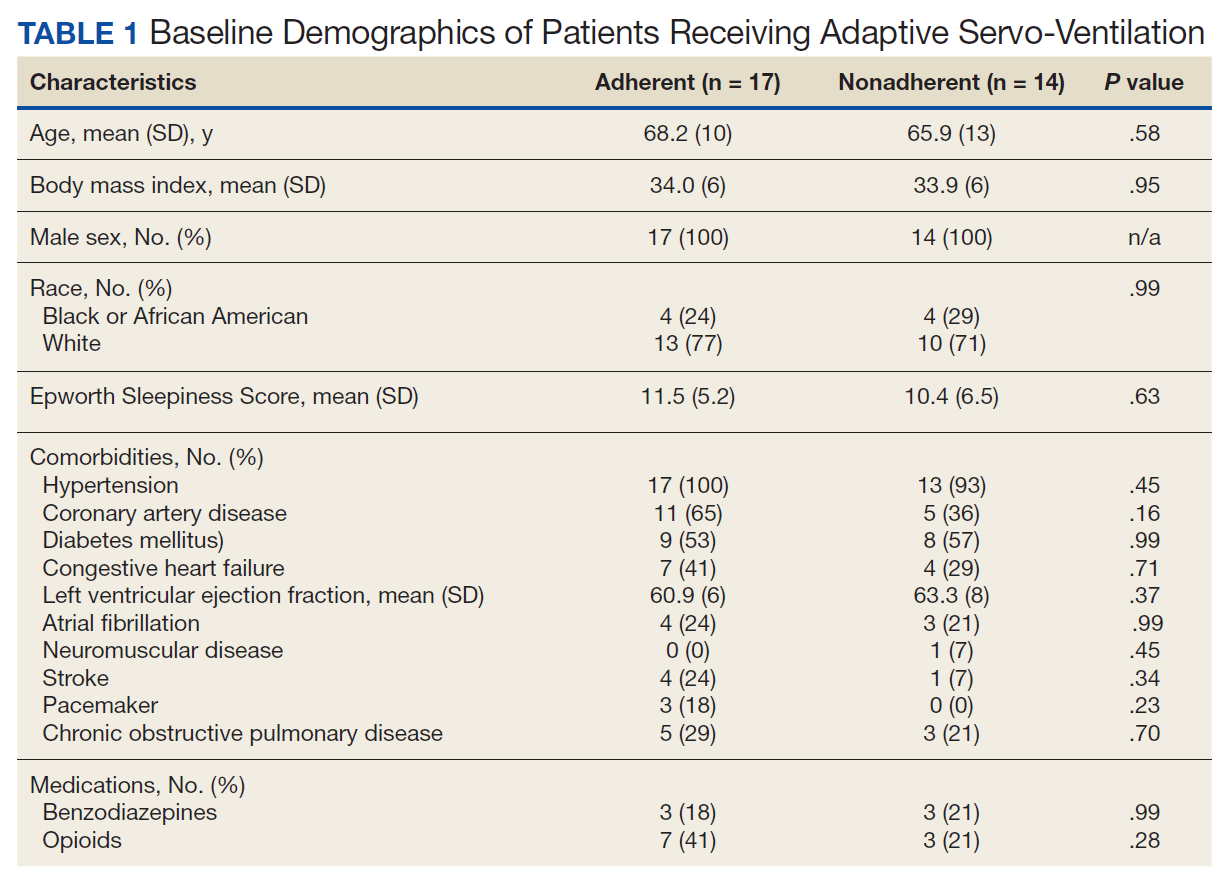
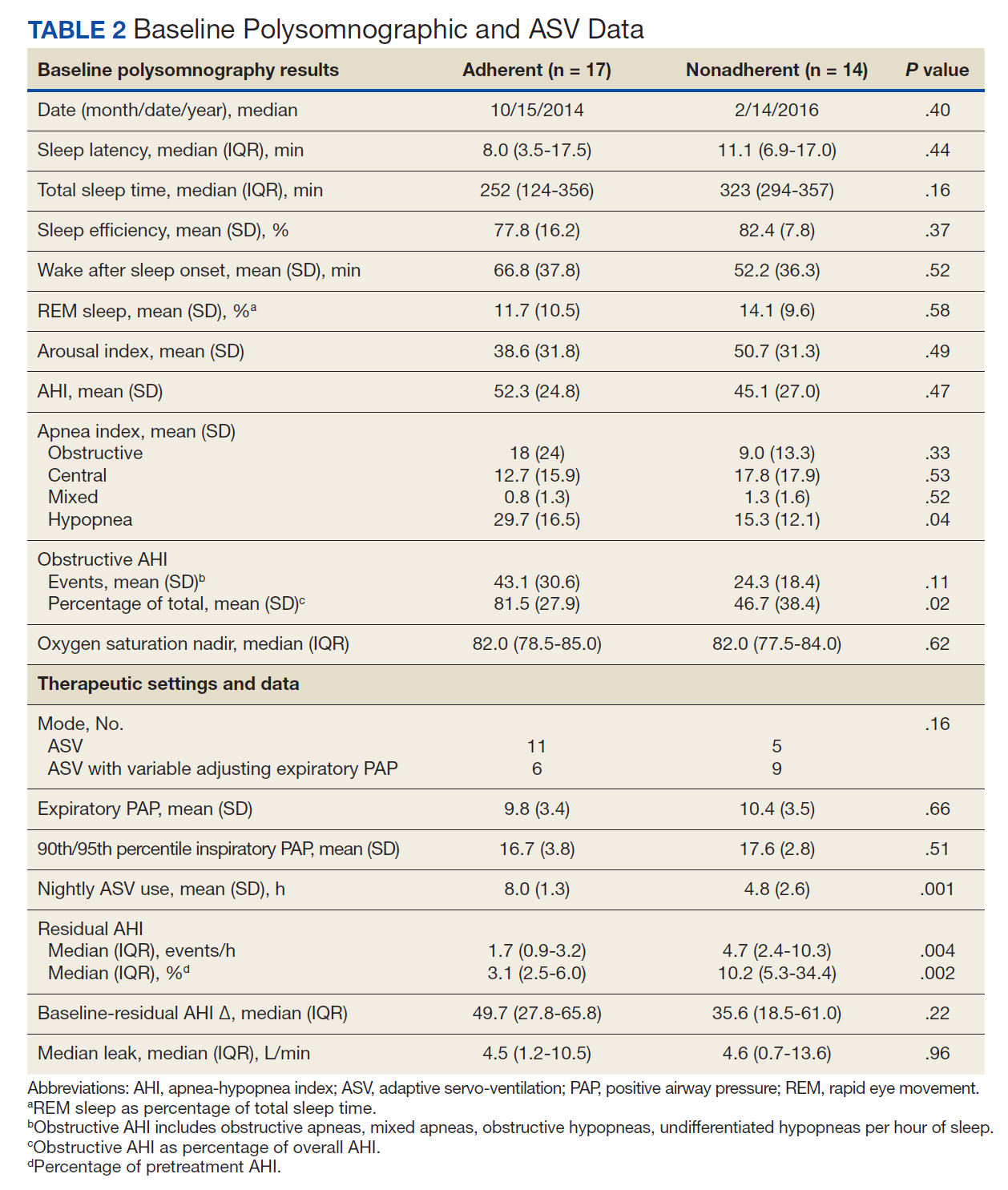
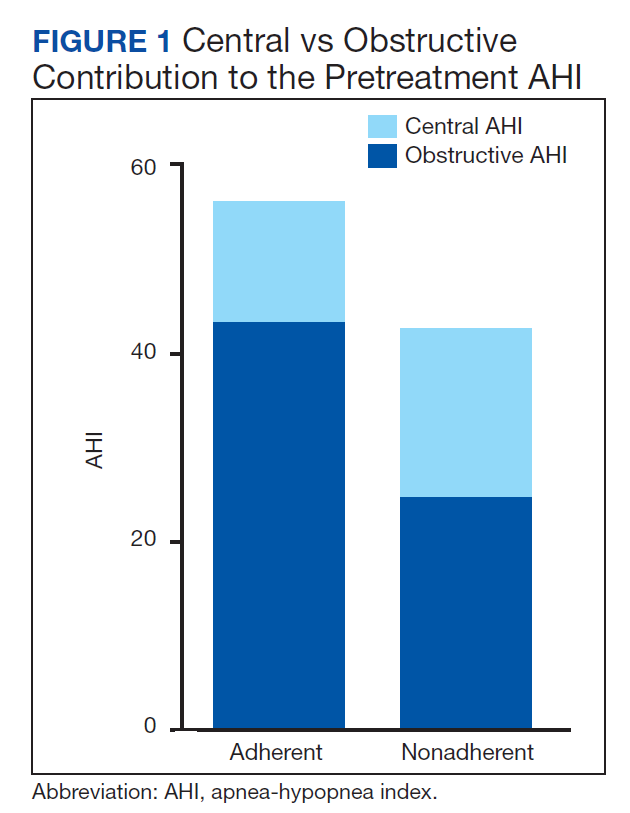
There were no significant differences between the proportions of patients on ASV with set EPAP or the titrated EPAP and IPAP. The median (IQR) residual AHI was lower in the adherent group compared with the nonadherent group, both in absolute values (1.7 [0.9-3.2] events/h vs 4.7 [2.4-10.3] events/h, respectively [P = .004]), and as a percentage of the pretreatment AHI (3.1% [2.5-6.0] vs 10.2% [5.3-34.4], respectively; P = .002) (Figure 2).
Primarily Obstructive Sleep Apnea
Sleep apnea was a mixed picture of obstructive and central events in many patients. Only 3 patients had “pure” CSA. Thus, we were unable to define discrete comparison groups based on the sleep-disordered breathing phenotype. We identified 19 patients with primarily OSA (ie, initially diagnosed with OSA, OSA with TECSA, or complex sleep apnea). The mean (SD) age was 66.1 (12.8) years, BMI was 36.2 (4.7), and ESS was 11.4 (5.6). The mean (SD) baseline AHI was 46.9 (29.5), obstructive AHI was 40.5 (30.4), and central AHI was 0.4 (1.2); the median (IQR) SpO2 nadir was 81% (78%-84%). The mean (SD) titrated EPAP was 10.2 (3.5) cm H2O, and the 90th/95th percentile IPAP was 17.9 (3.5) cm H2O. The mean (SD) usage of ASV was 7.9 (5.3) hours with 11 patients (58%) meeting the minimum standard for adherence to ASV therapy.
No significant differences were seen between the adherent and nonadherent groups in clinical or demographic characteristics or date of diagnostic sleep testing (eAppendix, available online at doi:10.12788/fp.0374). In baseline sleep studies the mean (SD) HI was 32.3 (15.8) in the adherent group compared with 14.7 (8.8) in the nonadherent group (P = .049). In contrast, obstructive AHI was not significantly lower in the adherent group: 51.9 (30.9) in the adherent group compared with 22.2 (20.6) in the nonadherent group (P = .09). The median (IQR) residual AHI on ASV as a percentage of the pretreatment AHI was 3.0% (2.4%-6.5%) in the adherent group compared with 11.3% (5.4%-89.1%) in the nonadherent group, a statistically significant difference (P = .01). No other significant differences were seen between the groups.


