
Procalcitonin-Guided Antibiotic Prescribing for Acute Exacerbations of Chronic Obstructive Pulmonary Disease in the Emergency Department


Purpose: Acute exacerbations of chronic obstructive pulmonary disease (AECOPD) can be caused by viral, bacterial, or environmental factors. Recent studies have suggested that procalcitonin serum levels may help reduce unnecessary antibiotic use without statistically significant differences in rates of treatment failure for AECOPD. The purpose of this quality improvement project was to create a procalcitonin-based algorithm to aid emergency department (ED) clinicians in the management of patients with AECOPD who do not require hospitalization and to evaluate its efficacy and practicality. The primary outcome of this project was the rate of antibiotic prescriptions before and after the initiation of the algorithm.
Methods: This study used an observational, retrospective, pre- and posteducation/intervention design. Clinicians were educated individually on the use of procalcitonin, and a copy of the algorithm was made available to each clinician and posted in the ED. Patients who were discharged from the ED with a diagnosis of an AECOPD were identified using International Classification of Diseases , Tenth Revision codes. Patient charts were reviewed from November 2018 to March 2019 for the preimplementation period and November 2019 to March 2020 for the postimplementation period. The rate of antibiotic prescriptions and the number of procalcitonin tests ordered before and after the introduction of the algorithm were analyzed. In addition, information on COPD Global Initiative for Chronic Obstructive Lung Disease (GOLD) grouping and 30-, 60-, and 90-day reexacerbation rates were collected. It was estimated that a sample size of 146 patients (73 patients/group) would provide 80% power to detect a between-group difference of 10% in the percentage of patients who were prescribed antibiotics. Categorical variables were expressed using estimates of their frequency and percentages. Percentages were compared using Fisher exact tests. For all tests, the significance level was set at 0.05.
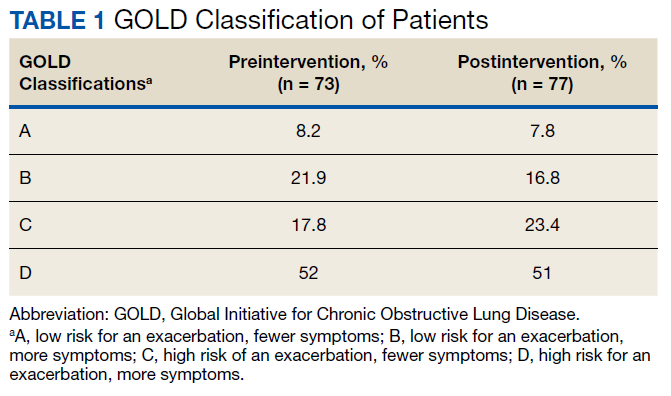
Results: Seventy-three patients were included in the preintervention group, and 77 patients were included in the postintervention group. Patients in the preintervention and postintervention groups had similar representation in GOLD categories: 52% and 51% for D, 17.8% and 23.4% for C, 21.9% and 16.8% for B, and 8.2% and 7.8% for A, respectively. The rate of antibiotic prescriptions decreased by 20% after implementation from 83.6% before to 63.6% after implementation ( P = .01). The differences in reexacerbation rates between the preintervention and postintervention groups were similar: 19.2% vs 23.4% at 30 days, 12.3% vs 11.7% at 60 days, and 4.1% vs 9.1% at 90 days, respectively. Prior to education and introduction of the procalcitonin algorithm, procalcitonin was ordered for 1.4% of AECOPD cases. Postimplementation, procalcitonin was ordered for 28.6% of AECOPD cases and used in clinical decision making 81.8% of the time .
Conclusions: In this study of the implementation of a treatment algorithm for patients with mild and moderate AECOPD who present to the ED, procalcitonin was shown to reduce the rate of antibiotic prescriptions without an observable difference in reexacerbation rates 30, 60, and 90 days after presentation.
Results
Seventy-three patients were included in the preintervention group and 77 in the postintervention group. The GOLD classification rates were similar between the groups (Table 1). In addition, > 90% of patients were White males and all patients were aged ≥ 50 years, which is characteristic of the US Department of Veterans Affairs (VA) population.
The percentage of antibiotic prescriptions decreased by 20% after implementation, falling from 83.6% before to 63.6% after the implementation (P =.01). The documented change in sputum color remained low compared with antibiotic prescriptions: 17.8% preimplementation and 16.9% postimplementation. The reduction in antibiotic prescriptions was associated with limited differences observed in 30-, 60-, and 90-day reexacerbation rates pre- and postintervention: 19.2% vs 23.4%, 12.3% vs 11.7%, and 4.1% vs 9.1%, respectively.
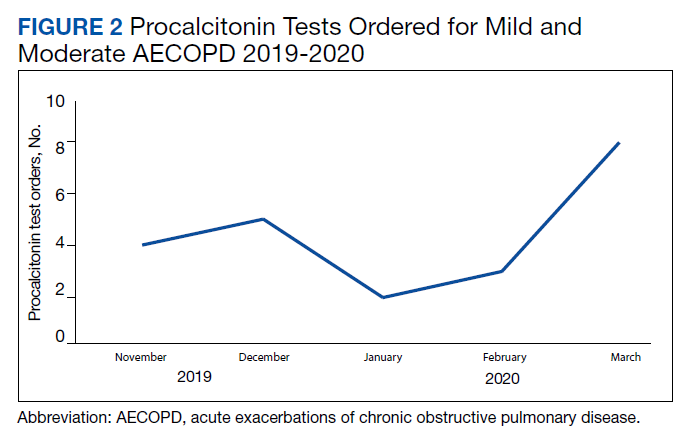
Prior to the education, introduction of the algorithm, and implementation of the PCT quick-order menu, PCT was ordered for 1.4% of AECOPD cases. Postintervention, PCT was ordered for 28.6% of mild-to-moderate AECOPD cases and used in clinical decision making per clinical documentation 81.8% of the time. PCT was used in 5 GOLD group B patients, 5 GOLD group C patients, and 7 GOLD group D patients. In all cases, PCT was < 0.25 ng/mL. In 4 cases PCT was ordered but not used: 1 GOLD group D patient refused traditional treatment with oral corticosteroids, which resulted in the clinician prescribing antibiotics, and the other 3 cases did not use PCT based on clinical decision making. The rate of PCT tests ordered for mild-to-moderate AECOPD over time is depicted in Figure 2.
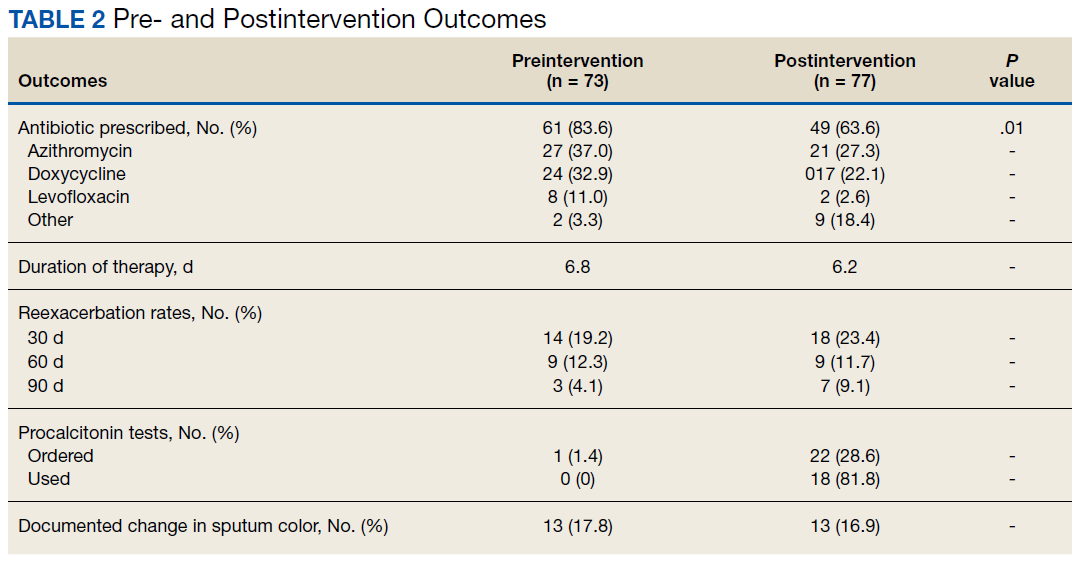
The average duration of antibiotic therapy was about 6 days pre- and postintervention. This is longer than the PVAHCS recommended duration of 5 days but is consistent with the GOLD guidelines recommended duration of 5 to 7 days.1 Azithromycin is recommended as a first-line treatment option at the PVAHCS based on the local antibiogram, and it remained the most commonly prescribed antibiotic pre- and postintervention. Outcomes of interest are detailed in Table 2.
Discussion
The implementation of PCT-guided antibiotic prescribing for patients with mild and moderate AECOPD who presented to the ED resulted in a 20% reduction in antibiotic prescriptions, falling from 83.6% before the intervention to 63.6% afterward (P = .01). The measured decrease in antibiotic prescriptions is consistent with other studies evaluating the use of acute phase reactants to guide antibiotic prescribing for AECOPD.10,11 In addition, there was no observed difference in reexacerbation rates. This adds to the increasing body of evidence that antibiotics are overprescribed in mild and moderate AECOPD.12 This is exemplified in our data by the low percentage of patients who had a documented change in sputum color; symptoms that are well known to be highly specific and sensitive for a bacterial infection in AECOPD.
Many health care providers (HCPs) in the ED were unfamiliar with PCT prior to implementation. A primary concern with this study was its impact on diagnostic stewardship. Preimplementation, ED clinicians ordered PCT 8 times for any cause. Postintervention, ED clinicians ordered PCT 180 times for any cause: 36% of these orders were for patients with AECOPD who were discharged from the ED or who required hospital admission. The other orders were for other respiratory conditions, including asthma exacerbations, pneumonia, bronchitis, sinusitis, pharyngitis, nonspecific respiratory infections, and respiratory failure.
The early phase of the COVID-19 pandemic coincided with the postintervention phase of this project. PVAHCS started preparing for the pandemic in March 2020, and the first confirmed diagnosis at the facility occurred mid-March. COVID-19 may have contributed to the sharp increase in PCT tests. There is currently no well-defined role for PCT in the diagnosis or management of COVID-19, but ED clinicians may have increased their use of PCT tests to help characterize the etiology of the large influx of patients presenting with respiratory symptoms.13


