
First EDition: News for and about the practice of Emergency Medicine


CDC updates guidance on protecting health care workers from Ebola; Malpractice reform failed to curb defensive medicine in the ED; New test will speed enterovirus D68 case confirmation from weeks to days; ED visits by young patients trended up in California; Pit bull bites are worse by several measures;Doubling of US heroin deaths spurs call for increased naloxone access; Opioid-poisoning deaths rose fastest in 55- to 64-year-olds.
Also, “efforts to prevent expansion of the number of OPR users who might use heroin when it is available should continue [including] screening for substance abuse, urine testing for drug use, and referral to substance abuse treatment. The use of prescription drug monitoring programs can address inappropriate opioid prescribing and further prevent OPR abuse,” they said.
In 2012, 25- to 34-year-olds had the highest heroin fatality rate; OPR fatalities were highest in those aged 45-54 years. Non-Hispanic whites had the highest rates for both. Men were four times more likely than women to die from a heroin overdose, but only slightly more likely to die from prescription pain pills.
“Heroin overdose death rates increased significantly for both sexes, all age groups, all census regions, and all racial/ethnic groups other than American Indians/Alaska Natives,” the researchers noted.
Meanwhile, from 2010 to 2012, pain pill overdoses declined significantly in men, people under 45 years old, those who live in the South, and non-Hispanic whites. They increased in people aged 55-64 years. aotto@frontlinemedcom.com
Opioid-poisoning deaths rose fastest in 55- to 64-year-olds
By: Lucas Franki
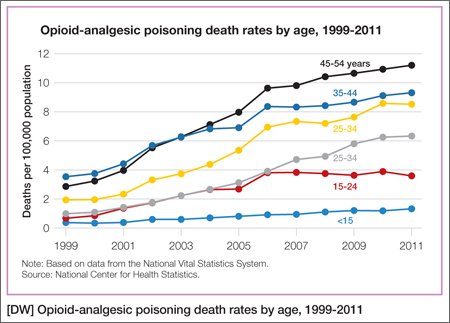
In 1999, the death rate for opioid analgesics was 1 per 100,000 people for adults aged 55-64 years. By 2011, this rate had increased to 6.3 per 100,000 people, the NCHS reported.
Non-Hispanic white adults had the largest increase in the rate of opioid-analgesic poisoning deaths among measured ethnicities, rising from 1.6 per 100,000 in 1999 to 7.3 in 2011. The death rate for non-Hispanic black adults increased from 0.9 per 100,000 in 1999 to 2.3 in 2011. Hispanic adults did not see a large rate increase, with 1.7 per 100,000 deaths in 1999 and 2 per 100,000 deaths in 2011 attributed to opioid-analgesic poisoning, according to data from the National Vital Statistics System.
lfranki@frontlinemedcom.com
Dr Lappin is an assistant professor and an attending physician, department of emergency medicine, New York-Presbyterian Hospital/ Weill Cornell Medical College, New York.

