
Emergency Care at a Music Festival: A First-Person Report


Lessons From the 2015 Festival
The 2015 EDM festival in Orlando had taken place without significant coordination between local EMS medical directors and ORMC, and was treated in a similar manner to other mass gatherings held in the area—ie, with extra EMS personnel on-site as well as several first aid stations. However, over the course of the 2015 event, the medics on-site were overwhelmed by the number of attendees seeking care, and felt obligated to transport a large number of these patients to ORMC (many of whom did not require hospital care), or to treat and release patients in a manner that was not in accordance with existing protocol.
As a result, the online medical control doctors at ORMC were overwhelmed by the sudden influx of calls for treat-and-release orders or intravenous (IV) hydration—not a common occurrence at this institution. This resulted in dozens of patient transports to the ED. Many of these patients did not require emergent care but simply needed shelter from the elements, rest because of sleep deprivation, or a place to recover from the effects of alcohol or drugs. Some patients, however, presented to ORMC in critical condition, two of whom died from suspected drug-related causes and/or severe hyperthermia.
After-Action Review
An after-action review of the 2015 EDM festival conducted by the Orlando Fire Department (OFD) concluded that significantly more medical support was needed for this and similar large-scale events in the future. Together with OFD, we examined how other regions in the United States handled similar festivals, and it became clear that a multidisciplinary approach, including a field hospital, EMS, ORMC, and festival planners, would be necessary for the 2016 festival.
Collaborative Planning for the 2016 Festival
Festival planners and promoters worked closely with the City of Orlando and EMS medical directors for months leading up to the 2016 EDM festival. The complexities of stage set-up alone required significant coordination, including the closure of several roads. To set up the field hospital, we first tried to acquire “real estate” on festival grounds. When this proved not to be feasible, we worked with city officials to create a field hospital on a street just outside the festival’s side gate.
Resources
Throughout the process, we worked closely with the festival’s planners, as well as a medical team designated by its parent company, to coordinate shared resources. The medical team provided a significant amount of medical supplies to our field hospital. In addition, the festival obtained and paid for an insurance rider extending coverage to our medical staff while working at the event.
Ground Control Staff
The planners and promoters of the EDM festival host several other festivals each year, including some that are larger and longer than the annual event held in Orlando. A small team from Orlando visited their set-up at a larger festival in Nevada several months prior to the 2016 EDM festival, gathering information on how we could best execute our plans. In addition to equipment and support, the festival also designated ground controllers (GCs) stationed throughout the festival area. These were individuals without medical training who could be easily identified and could guide those in need of medical attention to the nearest first aid station or to the field hospital, or contact us when someone was in need of immediate or emergent care.
Access and Communications
Several areas identified for improvement from 2015 included better ambulance access, radio communication (especially with physicians), and appropriate staffing. To provide additional medical staff for the 2016 EDM festival, the Office of the Medical Director (OMD) and the Central Florida Disaster Coalition (CFDC), a regional nonprofit organization that assists with disaster-health response in the area, utilized this event as a drill for a large-scale disaster that would require a self-sufficient field hospital. Part of this initiative included radio transmission equipment that would allow the routing of all 911 and other emergency calls from the festival grounds directly to on-site medical personnel.
In addition to the CFDC resources, we had dedicated medical control on the radio to answer questions from the paramedics staffing the outer first aid stations. This was separate from our normal medical control base-station process, and allowed our traditional EMS operating structure to continue outside the event without any confusion or added burden from within.
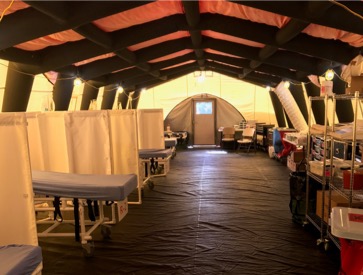
Field Hospital and First Aid Stations
Created just beyond the fencing that surrounded the event, the field hospital was a 3,200-square-foot, enclosed, air-conditioned structure powered by generators. In addition to the field hospital, three first aid stations were strategically placed around the festival grounds, and groups of medical personnel were assigned to walk the grounds.


