
Unclear Expectations


Patient placement will be another concern for hospitalists in the event of a widespread outbreak. The current CDC patient care guidelines say that all patients with confirmed or suspected H1N1 infection must be isolated. Although they can be scattered in rooms throughout the hospital, it is strongly suggested that they be placed together as a cohort, if possible.
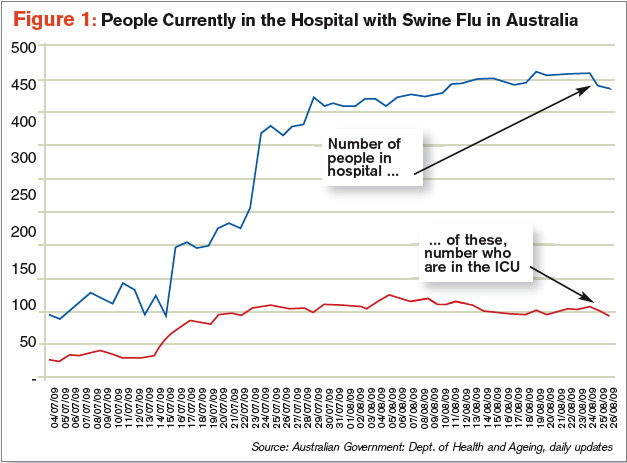
“Our hospital is looking into designating special areas of the hospital to accept influenza patients,” Dr. Wright says. “We can then give the staff special training on treatment and prevention, give better access to materials and supplies in a single location, and also minimize the time lost to physicians going from one patient to another.”
Staffing Concerns
One of the biggest concerns to HM groups is keeping their own areas of the hospital properly staffed. In addition to the possibility of higher acuity and admissions affecting coverage needs, most experts are suggesting employee absentee rates upward of 40%. To further complicate the picture, interim CDC guidelines say healthcare workers should be off work 24 hours after a fever subsides or seven days, whichever is longer. This guidance, however, could change as the CDC obtains and reviews more information.
“We are a small group of only four physicians,” says Dr. Schiopescu, whose HM group works a six-day on, six-day off schedule for about 85 encounters per week at her 50-bed hospital. “We may need to work additional shifts and be available to be called in early, should the need arise. We have also done some cross-training so that community physicians can help if needed. At worst, we can pull resources from our sister hospitals in the system.”
—Irina Schiopescu, MD, infectious-disease specialist, Roane Medical Center, Harriman, Tenn.
Some hospitals have been able to flex up and increase staffing levels before the season begins. “In addition to adding three full-time equivalent staff, we have actively looked for other specialties, such as internal medicine or family practice, that have the proper skill sets should the need arise,” says Dr. Wright, whose program covers 75% of the 471 medical beds at UW Hospital. “We have also developed a set of protocols to streamline treatment of these patients, no matter who may be taking care of them.”
Scripps is surveying its employees to identify family and other outside obligations that could lead to call-outs and staffing shortages. Hospital administrators expect that the information will identify physicians who might not be able to come to work. The hospital also implemented systems that will allow them to bring in extra people—and get them deployed quickly—from such state and federal support resources as the Public Health Service and the National Disaster Medical System staffs.

