Authors’ Disclosure Statement: The authors report no actual or potential conflict of interest in relation to this article.
Talus fractures with associated dislocations are rare but have high rates of complications, including avascular necrosis (AVN). Management of these injuries involves urgent surgical reduction and fixation, although there are no definitive data defining an operative time frame for preserving the blood supply and preventing complications.
To determine the effect of time to surgical reduction of talus fractures and talus fracture-dislocations on rates of AVN and posttraumatic osteoarthritis (PTOA), we retrospectively reviewed talus fractures surgically managed at a level I trauma center during the 10-year period 2003 to 2013. Operative reports were obtained and reviewed, and 3 independent reviewers, using the Hawkins and AO/OTA (Arbeitsgemeinschaft für Osteosynthesefragen/Orthopaedic Trauma Association) systems, classified the injuries on plain radiographs. Analysis of AO/OTA 81 fractures with associated tibiotalar, subtalar, or talonavicular dislocations was performed. Primary outcomes were presence of AVN/PTOA and subsequent arthrodesis of tibiotalar or subtalar joints.
We identified 106 surgically managed talus fractures. Rates of AVN/PTOA were 41% for all talus fractures and 50% for talus fracture-dislocations. Mean time to surgical reduction was not significant for development of AVN/PTOA for all talus fractures (P = .45) or talus fracture-dislocations (P = .29). There was no difference in age (P = .20), body mass index (P = .45), or polytrauma (P = .79) between patients who developed AVN and those who did not. Open fractures were significantly correlated with the development of AVN/PTOA (P = .009).
Talar fracture-dislocations are devastating injuries with high rates of complications. Our data suggest there is no effect of time from injury to surgical reduction of talus fractures or talus fracture-dislocations on rates of AVN and PTOA.
Results
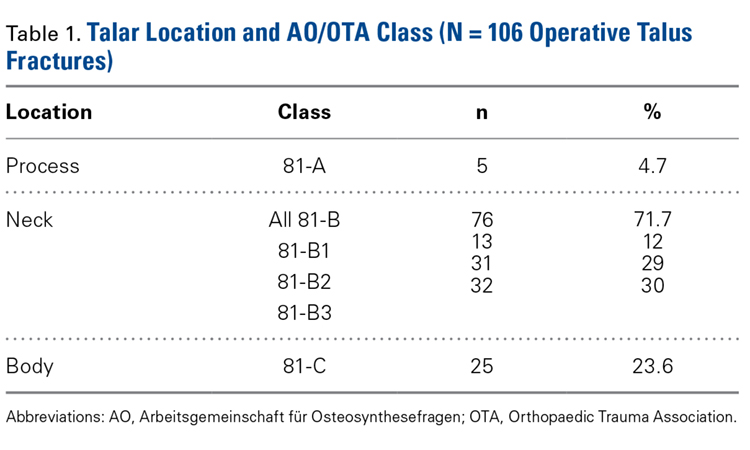
Classification Analysis (Table 1)
Table 1.
We identified 106 surgically managed talus fractures. Five (4.7%) were lateral process and talar head fractures (AO/OTA 81-A). Seventy-six (71.7%) were talar neck fractures (81-B), which included 13 (12%) 81-B1 fractures, 31 (29%) 81-B2 fractures, and 32 (30%) 81-B3 fractures. Twenty-five (23.6%) were talar body fractures (81-C). AO/OTA 81-B3 fractures were identified and separately analyzed and compared with talus fractures of all other classes. AO/OTA 81-B talar neck fractures were classified with the Hawkins system7 as well: 13 (12%) were Hawkins 1 fractures, 31 (29%) Hawkins 2 fractures, 25 (24%) Hawkins 3 fractures, and 7 (7%) Hawkins 4 fractures.
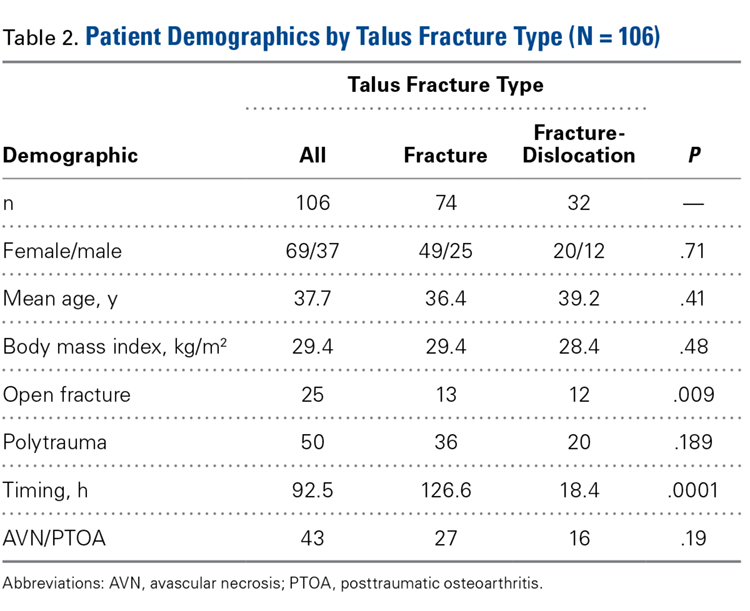
Subject Analysis (Table 2)
Table 2.
Of the 106 patients, 69 were female and 37 male. Mean age was 37.7 years (range, 18-78 years). Mean body mass index (BMI) was 29.45 kg/m2. Of the 106 cases, 52 were managed by board- certified orthopedic trauma surgeons, 32 by board- certified foot and ankle surgeons, and 22 by orthopedic surgeons with other specialty training.
The mechanisms of injury were motor vehicle accident (70/106; 66%), fall from height (25; 24%), misstep (4), sports related (2), object falling on ankle (2), and not reported (3).
Of the 106 patients, 45 (42%) had isolated talus injuries, 35 had concomitant ipsilateral lower extremity injuries, 25 had concomitant contralateral lower extremity injuries, and 1 had a concomitant upper extremity injury.
Smoking status was everyday (14 patients), past (10), never (34), and unreported (48). Five patients reported a history of alcohol abuse, and 4 patients reported illicit drug use. Two had a history of atrial fibrillation, 9 had hypertension, 3 had hyperlipidemia, 3 had renal disease, 3 had heart disease, 4 had diabetes, 3 had lung disease, and 1 had a history of lung cancer.
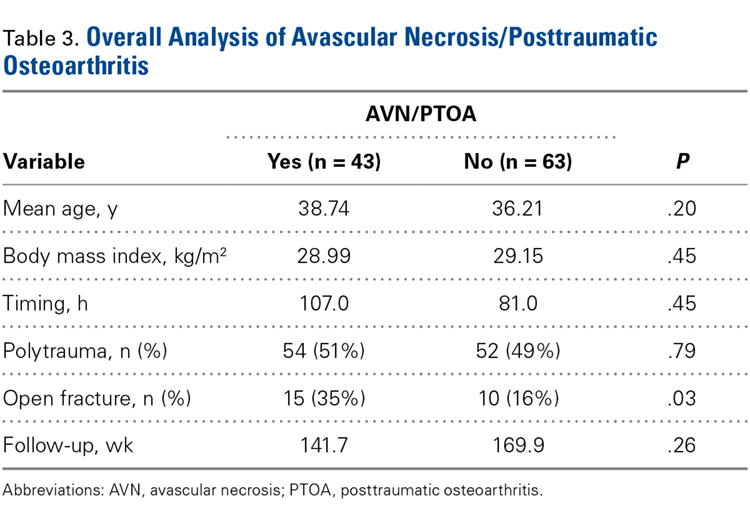
Overall Analysis of AVN/PTOA (Table 3)
Table 3.
Of the 106 patients, 43 (41%) developed AVN/PTOA, and 63 (59%) did not, while fifty-four (51%) of the 106 patients who developed AVN/PTOA had polytrauma, and 52 (49%) of those who did not develop AVN/PTOA had polytrauma (P = .79). There was no significant difference in mean age (38.74 years for AVN/PTOA, 36.21 years for no AVN/PTOA; P = .20) or BMI (28.99 kg/m2 for AVN/PTOA, 29.15 kg/m2 for no AVN/PTOA; P = .45). Direct comparison of proportions of polytrauma to development of AVN/PTOA revealed no significant difference. Direct comparison of the proportions of open injuries to development of AVN/PTOA revealed a significant difference. Fifteen (35%) of the 43 patients who developed AVN/PTOA had open injuries, and 10 (16%) of the 63 who did not develop AVN/PTOA had open injuries (P = .03). There was no significant difference in follow-up between patients who developed AVN/PTOA and those who did not (P = .26).
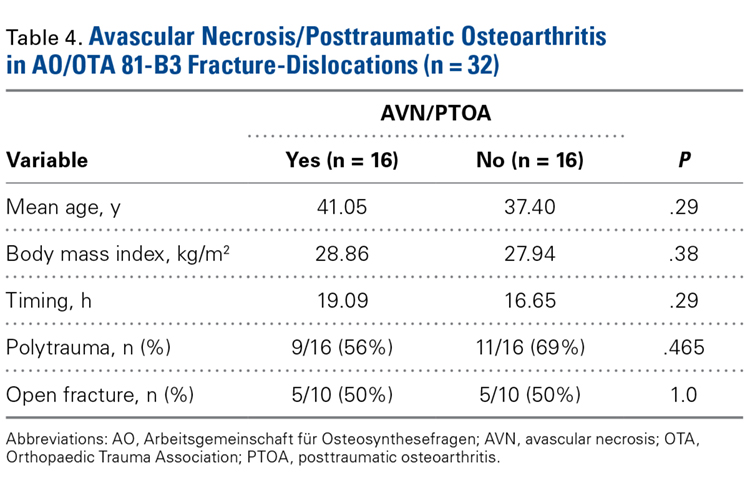
Analysis of AVN/PTOA in 81-B3 Fracture-Dislocations (Table 4)
Table 4.
Of the 32 patients with AO/OTA 81-B3 (Hawkins 3 or 4) fractures, 16 (50%) developed AVN/PTOA, and 16 did not. There was no significant difference in mean age (41.05 years for AVN/PTOA, 37.40 years for no AVN/PTOA; P = .29), BMI (28.86 kg/m2 for AVN/PTOA, 27.94 kg/m2 for no AVN/PTOA; P = .38), or surgical timing (19.09 hours for AVN/PTOA, 16.65 hours for no AVN/PTOA; P = .29) for development of AVN/PTOA. Direct comparison of the proportions of polytrauma and open injuries to development of AVN/PTOA in patients with 81-B3 fracture- dislocations revealed no significant difference. Nine of the 16 patients (56%) who developed AVN/PTOA had polytrauma, and 11 of the 16 (69%) who did not develop AVN/PTOA had polytrauma (P = .465). Although open injury was found to predict AVN/PTOA overall, this was not true for talus fracture-dislocations alone. Five of the 10 patients who developed AVN/PTOA had open injuries, and 5 of the 10 who did not develop AVN/PTOA had open injuries (P = 1.0). There was a significant difference in follow-up time between these groups. Patients who had 81-B3 fracture-dislocations and developed AVN/PTOA were followed for a mean of 120.4 weeks, and those who did not develop AVN/PTOA were followed for a mean of 40.33 weeks (P = .001).