ADVERTISEMENT

Report Critical Care

The Hospitalist. 2008 March;2008(03):

click for large version

Service Inclusions

Critical care involves highly complex decision making to manage the patient’s condition. This includes the physician’s performance and/or interpretation of labs, diagnostic studies, and procedures inherent in critical care.

Therefore, do not report the following services when billing 99291-99292:

  • Cardiac output measurements (93561, 93562);
  • Chest X-rays (71010, 71015, 71020);
  • Pulse oximetry (94760, 94761, 94762); and
  • Blood gases (multiple codes).

Further, don’t report interpretation of data stored in computers:

  • Electrocardiograms, blood pressures, hematologic data (99090);
  • Gastric intubation (43752, 91105);
  • Temporary transcutaneous pacing (92953);
  • Ventilation management (94002-94004, 94660, 94662); and
  • Vascular access procedures (36000, 36410, 36415, 36591, 36600).

Any other service or procedure provided by the physician can be billed in addition to 99291-99292.

Be sure not to add separately billable procedure time into the physician’s total critical-care time. A notation in the medical record should reflect this (e.g., time spent inserting a central line is not included in today’s critical-care time).

Location

Because a patient can become seriously ill in any setting, physicians often provide critical-care services in emergency departments (EDs) and on standard medical-surgical floors before the patient is transferred to the intensive care unit (ICU).

Bed location alone does not determine critical-care reporting. Patients assigned to an ICU might be critically ill or injured and meet the “condition” requirements for 99291-99292.

However, the care provided may not meet the remaining requirements. According to the American Medical Association’s Current Procedural Terminology 2008 (Professional Edition) and the Medicare Claims Processing Manual, payment can be made for critical-care services provided in any location as long as the care provided meets the definition of critical care. Services for a patient who is not critically ill and unstable but who happens to be receiving care in a critical-care, intensive-care, or other specialized-care unit are reported using subsequent hospital care codes 99231-99233 or hospital consultation codes 99251-99255. TH

Carol Pohlig is a billing and coding expert with the University of Pennsylvania Medical Center, Philadelphia. She is also on the faculty of SHM’s inpatient coding course.

Code These Cases

Case 1 (family meetings): The hospitalist provides 45 minutes of critical care to a patient admitted with septicemia. The patient’s condition worsens despite multiple efforts, and the patient’s family arrives later in the day to discuss the patient’s condition. The discussion lasts an additional 30 minutes, and the decision regarding the patient’s do not resuscitate status is made. What service(s) should the hospitalist report?

The Solution

Family meeting time can be counted toward critical-care service time when:

  • The patient is unable or clinically incompetent to participate in discussions;
  • Time is spent on the unit/floor with family members or surrogate decision makers obtaining a medical history, reviewing the patient’s condition or prognosis, or discussing treatment or limitation(s) of treatment may be reported as critical care;
  • The conversation bears directly on the management of the patient. Meetings that take place for grief counseling involving the patient’s family (90846, 90847, 90849) are not reported separately or included as part of the critical-care time.

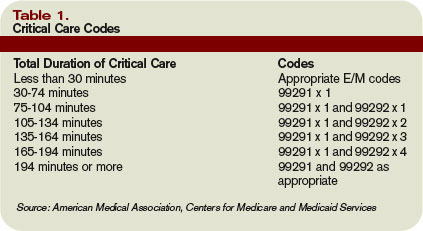
This scenario meets the criteria for inclusion in critical-care time. A total of 75 minutes was spent for the day. The hospitalist can report one unit of 99291 and one unit of 99292.

Note: A common physician-reporting error for the scenario above involves reporting 99291 with a prolonged care (99356-99357) or subsequent hospital care codes (99231-99233). Prolonged care is reserved for use with initial hospital care (99221-99223), subsequent hospital care (99231-99233), and inpatient consultation codes (99251-99255).

Reporting subsequent hospital care codes for the family meeting is also erroneous since the patient had received critical care for the day. As per Medicare guidelines, both critical care and an E/M service can be paid (appending modifier 25 to the E/M: 99291, 99233-25), but only if the inpatient E/M service was furnished early in the day when the patient did not require critical care, yet required it later that same day. Documentation must support this situation because it will need to be sent to the insurer before payment is obtained. Once critical care is initiated, subsequent evaluations on the same day are counted toward critical-care time, as in this scenario.

Case 2 (multiple physicians): The hospitalist sees the patient upon admission to the ICU, spending and documenting 40 minutes of critical-care time. That evening, the covering physician (a hospitalist from the same group practice) renders 35 minutes of critical care. Can each hospitalist submit a claim for 99291?

The Solution

No. Only one physician per group practice (same specialty) can report 99291 per day. The additional time is captured with 99292. Because 99292 must be reported as an add-on code with 99291 (i.e., cannot be reported by itself on a claim), submit one claim representing the culmination of all critical-care services provided by the group for the day. Select one physician’s name (typically the physician who initiated critical care), and report one unit of 99291 with one unit of 99292 for the 75 minutes of critical care provided.