
Memoirs of an ED Physician in a Tornado


Editor’s Note: Dr. Kevin Kikta was one of two emergency physicians on duty at St. John’s Regional Medical Center in Joplin, Mo., on Sunday, May 22, when an EF-5 tornado struck the hospital.
You never know that it will be the most important day of your life until the day is over. The day started like any other day for me: waking up, eating, going to the gym, showering, and going to my 4 p.m. emergency department shift. As I drove to the hospital, I mentally prepared for my shift as I always do, but nothing could ever have prepared me for what was going to happen.
Things were normal for the first hour and half. At approximately 5:30 p.m., we received a warning that a tornado had been spotted. Although I work in Joplin and went to medical school in Oklahoma, I primarily live in New Jersey and had never seen or been in a tornado. I learned that a "code gray" was being called. We were to start bringing patients to safer spots within the ED and hospital.
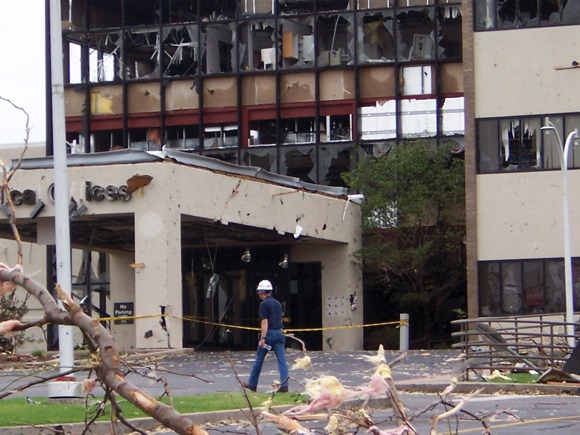
At 5:42 p.m., a security guard yelled to everyone, "Take cover! We are about to get hit by a tornado!" While others scattered to various places, I ran with a pregnant RN, Shilo Cook, to the only place that I was familiar with in the hospital without windows – a small doctor’s office in the ED. Together, Shilo and I trembled and huddled under a desk. We heard a loud horrifying sound like a large locomotive ripping through the hospital. The whole hospital shook and vibrated as we heard glass shattering, light bulbs popping, walls collapsing, people screaming, the ceiling caving in above us, and water pipes breaking, showering water down on everything. We suffered this in complete darkness, unaware of anyone else’s status, worried and scared. We could feel a tight pressure in our heads as the tornado annihilated the hospital and the surrounding area. The whole process took about 45 seconds, but it seemed like an eternity. The hospital had just taken a direct hit from a category EF-5 tornado.
Then it was over. Just 45 seconds ... 45 long seconds. We looked at each other, terrified, and thanked God that we were alive. We didn’t know, but hoped that it was safe enough to go back out to the ED, find the rest of the staff and patients, and assess our losses.
"Like a bomb went off" – that’s the only way that I can describe what we saw next. Patients were coming into the ED in droves. It was absolute, utter chaos. They were limping, bleeding, crying, terrified, with debris and glass sticking out of them, just thankful to be alive. The floor was covered with about 3 inches of water. There was no power, not even backup generators, rendering it completely dark and eerie in the ED. The frightening aroma of methane gas leaking from the broken gas lines permeated the air – we knew, but did not dare mention aloud, what that meant. I redoubled my pace.
We had to use flashlights to find the crying and wounded. Where did all the flashlights come from? I’ll never know, but immediately, and thankfully, my years of training in emergency procedures kicked in. There was no power, but our mental generators were up and running, and on high-test adrenaline. We had no cell phone service in the first hour, so we were not even able to call for help and backup in the ED.
I remember a patient in his early 20s gasping for breath, telling me that he was going to die. After a quick exam, I removed the large shard of glass from his back, made the clinical diagnosis of a pneumothorax (collapsed lung) and gathered supplies from wherever I could locate them to insert a thoracostomy tube in him. He was a trooper – I’ll never forget his courage. He allowed me to do this without any local anesthetic since none could be found. With his life-threatening injuries, I knew he was running out of time and it had to be done quickly. Imagine my relief when I heard a big rush of air and breath sounds again. Fortunately, I was able to get him transported out.
I immediately moved on to the next patient, an asthmatic in status asthmaticus. We didn’t have the option of trying a nebulizer treatment or steroids, but I was able to get him intubated using a flashlight that I held in my mouth.

