
Improving Access to Germline Testing for Patients With Prostate Cancer


Background: There is limited research examining demographic, disease-related, and social factors that may influence veterans’ participation in germline genetic testing. This study sought to identify whether demographic, disease-related, and social factors influence decisions regarding participation in prostate germline testing among veterans diagnosed with high-risk, very high-risk, or metastatic prostate malignancy.
Methods: Patient demographic and clinical information were collected and analyzed using descriptive statistics.
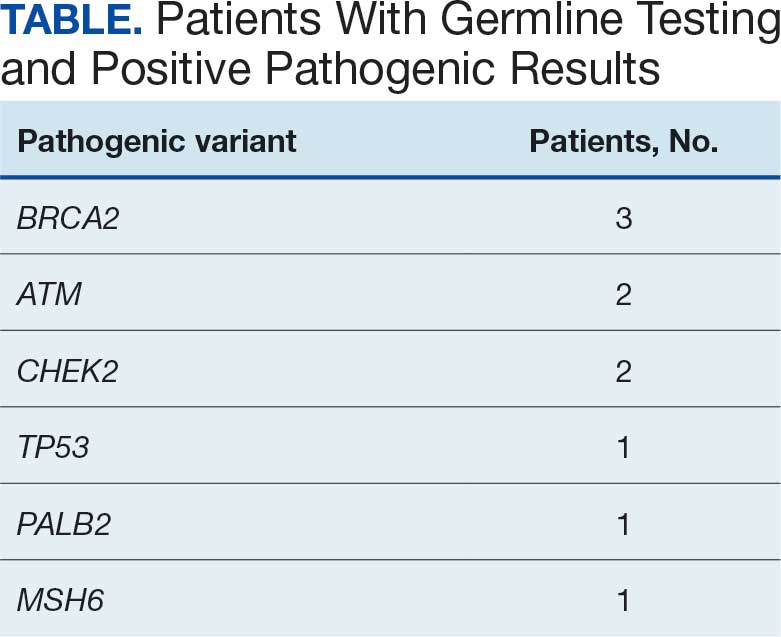
Results: A total of 171 electronic health records were analyzed. The mean age was 73 years and 132 (77%) participants were African American. Only 4 patients (2%) declined testing. Those who declined testing lived 6 to 18 miles from the testing center. Of the 171 patients, 167 (98%) agreed to germline testing: 126 (74%) tested negative for pathogenic variants, 10 (6%) tested positive for pathogenic variants, 30 (18%) had indeterminate findings, and 1 (1%) had a variant of unknown significance. Four patients (2%) with pathogenic variants received targeted therapy. The most common pathogenic finding was BRCA2 (3 cases), followed by ATM and CHEK2. Other pathogenic findings included TP53, PALB2, and MSH6. All patients with a pathogenic finding had no history of other primary malignancy. Most patients with pathogenic variants had metastatic disease.
Conclusions: Efforts to promote germline genetic testing resulted in substantial patient participation. Distance from their residence to the testing site did not seem to influence patients’ willingness to participate in testing.
With the onset of precision oncology, findings from germline mutational analysis have not only been helpful in treating veterans with cancer but also aid in cancer prevention, screening, early detection, increased chances for curative treatment and improved overall outcomes not only for the veteran patients but also for their families. This study sought to identify whether certain demographic, disease-related and social factors may be influencing decisions on participation in prostate germline testing among veterans diagnosed with high-risk, very high-risk or metastatic prostate malignancy and to identify the incidence of pathogenic mutations and their impact on treatment.
Methods
Data were collected from August 1, 2022, to December 31, 2023, among veterans with high-risk, very high-risk, or metastatic prostate cancer who were seen in medical oncology clinics and received education on the benefits of prostate germline genetic testing at the John D. Dingell Veterans Affairs Medical Center (JDDVAMC), an urban teaching hospital. The Wayne State University Institutional Review Board reviewed and approved this study.
A retrospective analysis of electronic health records was conducted to collect demographic and clinical information, including age, sex, race, extent of disease (high-risk, very high-risk, or metastatic disease), significant comorbidities, educational level, family or personal history of cancer, travel time, finding of pathogenic or likely pathogenic variants, impact on treatment approaches, referral for genetic counseling, and whether the veteran agreed or declined germline genetic testing. Significant comorbidities analyzed in this study included potentially serious, progressive, incurable and/or symptom-associated illnesses such as coronary artery disease, chronic heart failure, significant cardiac dysrhythmia, aneurysm, chronic obstructive pulmonary disease, pulmonary hypertension, end-stage renal disease, chronic kidney disease, terminal neurological conditions, diabetes mellitus, HIV, and liver cirrhosis. Microsoft Excel was used to calculate descriptive statistics.
Results
A total of 171 electronic health records of hematology/ oncology patients at JDDVAMC were analyzed. The mean age of included veterans was 73 years (range, 55-101 years), 132 participants (77%) were African American, 36 (21%) were White, 1 patient (1%) was Native Hawaiian/Pacific Islander, and 2 (1%) declined to answer. Only 22 EHRs (13%) reviewed contained information on patient education.
Four patients (2%) declined germline testing. These patients lived between 6 and 18 miles from the JDDVAMC and their ages ranged from 67 to 88 years. One of the patients who declined testing had a family history of cancer (throat cancer). Of those who declined testing, 2 had high-risk prostate cancer and 1 had metastatic disease. All patients who declined testing had ≤ 1 serious comorbid conditions; 1 patient had coexisting metastatic carcinoid tumor of the colon.
Of the 171 included patients, 167 (98%) agreed to germline testing. These patients lived from < 1 to 68 miles from the testing center. Ages ranged from 55 to 101 years. Prostate cancer was the most common family history of malignancy among patients who had negative germline genetic testing. Germline testing results included 126 patients (74%) who tested negative for pathogenic variants, 10 (6%) had pathogenic variants, 30 (18%) had indeterminate findings, and 1 (1%) had a variant of unknown significance. Seventeen participants with indeterminate findings were referred for genetic counseling. Of the 10 patients who tested positive for pathogenic variants, 4 were amenable to the use of targeted therapy. All patients with pathogenic variants were referred for genetic counseling.
Three patients had BRCA2 pathogenic variants, 2 patients had ATM variants, and 2 patients had CHEK2 variants. Additional pathogenic findings included TP53, PALB2, and MSH6 (Table). All patients with had a pathogenic finding had no history of other primary malignancies. Breast, lung, and prostate cancer were most common in the family histories for patients with pathogenic findings, while others noted histories of throat, uterine, brain, and colon cancers. Patients with pathogenic variants had a median of 1 serious comorbidity. Patients with negative findings had a median of 3 serious comorbidities.
Discussion
The National Comprehensive Cancer Network (NCCN) recommends germline genetic testing for patients with a personal history of prostate cancer in the following cases: metastatic, regional (node positive), high-risk or very high-risk localized, a personal history of breast cancer, Ashkenazi Jewish ancestry, certain types of family history of cancer, family history of certain types of hereditary cancer syndromes, and family history of familial cancer risk mutations in certain variants.1
According to the NCCN, high-risk prostate cancer patients are those that do not have very high-risk features, clinical stage T3a, Grade Group 4 or Grade Group 5, or have a prostate-specific antigen (PSA) > 20 ng/mL.2 Those with very high-risk disease have ≥ 1 of the following: clinically staged at cT3b or cT4, primary Gleason pattern 5, 2 or 3 high-risk features, > 4 cores with Grade Group 4 or Grade Group 5.
A study by Loeb et al that included 132 US urologists from 6 different urological associations, social media, and the US Department of Veterans Affairs (VA) Urology Mailgroup found that ≤ 33% of respondents do not perform or refer patients to a genetic counselor for prostate germline testing. Loeb et al also found that younger urologists, academic practice, and specialization in prostate cancer or oncology were factors associated with a tendency to perform genetic testing or place a referral to a counselor.3 These findings are consistent with data from this study that showed that a large population of patients seen by medical oncology were offered germline genetic testing and referred for genetic counseling.
A study of 37 men from 7 focus groups found that the participants valued genetic counseling and testing for familial implications but often did not associate prostate cancer genetics to risks for malignancies with their female relatives.4 Most patients who had pathogenic variants in this study had a family history of breast cancer.
Pathogenic variants found in this study are consistent with those found in the literature. Giri et al found germline mutations in up to 12% to 17% of men diagnosed with metastatic prostate cancer including the DNA repair genes BRCA2, CHEK2, BRCA1, ATM, PALB2, and the DNA mismatch repair (MMR) genes, which have resulted to additional therapeutic options.5 BRCA2 and possibly ATM mutations have been associated with upgraded biopsies among men with early-stage disease receiving active surveillance. BRCA2 mutations also have been associated with increased findings of prostate cancer, younger age at diagnosis, and more clinically significant diseases. BRCA1 and BRCA2 have also been associated with hereditary breast and ovarian cancer whereas DNA MMR genes (eg, MLH1, MSH2, PMS2, MSH6, and EPCAM) have been associated with Lynch syndrome. This finding supports the contention by Giri et al that prostate germline testing may be impactful for patients and their blood relatives.5 A study using VA National Precision Oncology Program data showed that heavily pretreated patients with prostate cancer carrying a BRCA2 variant had significant PSA response and a progression-free survival (PFS) of > 7 months with the use of a poly (ADP-ribose) polymerase inhibitors.6
The GENTleMEN study examined the use of an online platform to complete a demographic and family cancer history and obtain informed consent for genetic testing among 816 men with metastatic prostate cancer.7 Sixty-eight percent of participants completed genetic testing and 9% of those who were tested had a pathogenic or likely pathogenic variant in ≥ 1 of the following germline DNA repair gene: CHEK2, BRCA2, ATM, NBN1, BRCA1, PALB2, PMS2, and MSH6. Genetic testing was performed using a mailed saliva sample and patients whose results showed a germline pathogenic or likely pathogenic variant were notified by phone or email and offered phone-based or telehealth genetic counseling. Patients who were non-Hispanic White, married, highly educated, or from a higher-income group were more likely to complete testing in the GENTleMEN study.7 Loeb et al found that social media activity and engagement across different platforms on BRCA and genetic testing was much lower for patients with prostate cancer when compared to patients with breast cancer.8
A review by Valle et al of 2448 Black and White US veterans diagnosed with prostate cancer who had somatic and putative germline genetic alterations showed no difference in genetic alterations for US Food and Drug Administration-approved targetable therapies or potentially actionable alterations between the 2 cohorts. However, Valle et al did find a higher rate of putative germline genetic alteration among White veterans.9 Johnson et al found that Black men are underrepresented in genomic studies compared to European American men.10 A associated studies showed that men of African American ancestry had a genetic risk score that was > 2 times higher than men of European ancestry, and men of East Asian ancestry had risk scores that were lower compared to men of European ancestry.11 Unlike what is frequently seen in the literature, African American patients comprised most participants in this study.
There was much better participation in testing among the veterans at JDDVAMC in this study compared with the private sector where it ranges from 5% to 15%, especially among African American patients.12 The low number of patients who declined to participate in testing may in part be attributable to the ease of getting the test done within the Veterans Health Administration with relatively low to no financial burden.
Other notable findings from this study included no association between age and participation in germline genetic testing; participants ranged in age from 55 to 101 years. Of the patients who declined to participate in germline testing, only 1 had a family history of throat and not prostate cancer. Patients who declined testing appeared to be in better health when compared with patients who were tested, with a median of 1 serious comorbid condition. It is also worth noting that most of the patients who had pathogenic variants had metastatic disease.
Limitations
There was limited information available on the educational level of the participants. More research is needed to establish its impact on participation in germline genetic testing. Participant ages varied widely, which warrants more scrutiny on the role of age in germline genetic testing participation in future work. The study was also limited by the small number of patients who declined testing, which restricted the ability to draw conclusions regarding factors associated with refusal. The reasons why patients refused testing were also not collected, which could have given additional insight that may be helpful in future studies. Findings from this study population may not be representative of other VAMC or nonveteran populations.
Conclusions
When compared with existing data, findings from this study showed patients seen by medical oncology are more likely to be offered germline genetic testing and genetic counseling likely because findings can help determine options for medications. Most patients who had pathogenic variants in this study had a family history of breast cancer. The literature suggests that many patients with prostate cancer do not recognize the potential hereditary association between prostate cancer and breast cancer. This finding reinforces the need to enhance education among patients on inherited risks for cancer including genetics. African American patients, a population that tends to be underrepresented in research, comprised most participants in this study. This is likely because the study is set at a location with a large African American population as well as the effort of clinicians to encourage germline genetic testing.
