
ADVERTISEMENT

Growth Spurt

The Hospitalist. 2010 January;2010(01):

Despite intravenous medication, a young boy in status epilepticus had the pediatric ICU team at the University of Wisconsin School of Medicine and Public Health in Madison stumped. The team called for a consult with the Integrative Medicine Program, which works with licensed acupuncturists and has been affiliated with the department of family medicine since 2001. Acupuncture’s efficacy in this setting has not been validated, but it has been shown to ease chemotherapy-induced nausea and vomiting, as well as radiation-induced xerostomia.1,2

Following several treatments by a licensed acupuncturist and continued conventional care, the boy’s seizures subsided and he was transitioned to the medical floor. Did the acupuncture contribute to bringing the seizures under control? “I can’t say that it was the acupuncture—it was probably a function of all the therapies working together,” says David P. Rakel, MD, assistant professor and director of UW’s Integrative Medicine Program.

The UW case illustrates both current trends and the constant conundrum that surrounds hospital-based complementary medicine: Complementary and alternative medicine’s use is increasing in some U.S. hospitals, yet the existing research evidence for the efficacy of its multiple modalities is decidedly mixed.

Even if your hospital does not offer complementary and alternative medicine (CAM), your patients are using CAM at ever-increasing rates. In 1993, 34% of Americans reported using some type of CAM (e.g., supplements, massage therapy, prayer, and so on). That number has almost doubled to 62%.3 Americans spend $47 billion a year—of their own money—for CAM therapies, chiropractors, acupuncturists, and massage therapists. And older patients with chronic conditions—the kind of patient hospitalists are most familiar with—tend to try CAM more than younger patients.4

These trends can directly affect hospitalists’ treatment decisions, but they also play a part in how you establish communication and trust with your patients, and how you keep your patients safe from adverse drug interactions. According to the National Academy of Sciences, in order to effectively counsel patients and ensure high-quality comprehensive care, conventional professionals need more CAM-related education.5
One Hospitalist’s Journey into Integrative Medicine

As an undergraduate, Suzanne Bertisch, MD, MPH, studied anthropology and was drawn to explore a variety of alternative healing systems. “I was fascinated,” she says, noting her study of Native American healers, chi gong healers, and others. She volunteered in cultural centers to learn more before following a conventional medical school route. After completing her residency at Beth Israel Deaconess Medical Center in Boston, an opportunity to apply for a fellowship in integrative medicine seemed a good fit, she says, to explore her dual interests in allopathic and integrative medicine. This summer, she will conduct a study of the underlying physiology of yoga and the effects of yogic breathing on the autonomic nervous system. Her approach to integrative medicine is to remain skeptical, design appropriate investigations, and to expand the applications of workable modalities within conventional medicine.—GH

click for large version
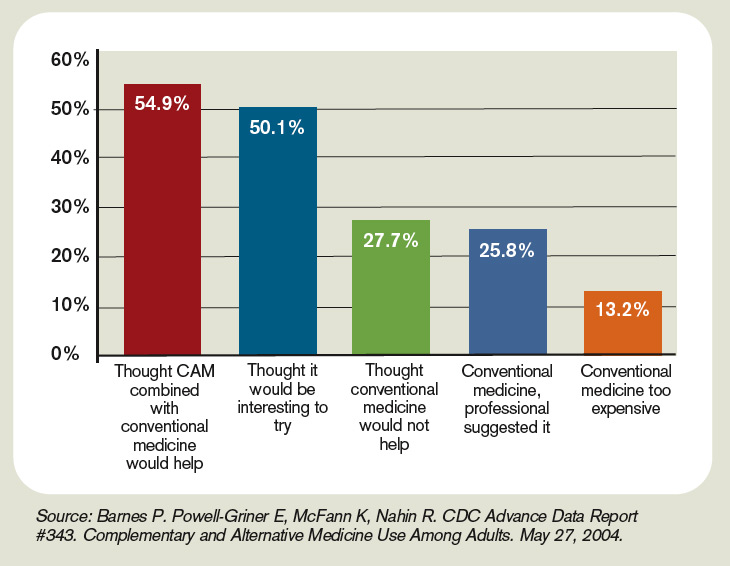
Figure 1: Reasons People Use CAM
click for large version
Figure 2: CAM Services by Hospital Size

Glossary of Complementary Terms

  • Acupuncture: Stimulating anatomical points on the body, known as “meridians,” using thin metallic needles.
  • Aromatherapy: Use of essential oils from plants to promote health and well-being.
  • Guided imagery: Mental exercises in which the patient imagines positive outcomes; commonly used to increase confidence and performance for athletes.
  • Massage therapy: Manipulation of muscles and connective tissue to enhance tissue function and promote relaxation.
  • Pet therapy: Incorporation of domestic animals, usually dogs, cats, or birds, into a facility based on findings that patients experience heightened well-being from contact with animals.
  • Reiki: Based on the belief spiritual energy is channeled through a practitioner, this modality is said to heal the patient’s spirit, which in turn heals the physical body.
  • Therapeutic touch: A method of healing that actually does not include physical contact. The practitioner passes his or her hands above the patient’s body in a wavelike motion to rebalance the body’s energy fields.

Sources: NCCAM; The Alternative Medicine Handbook, by Barrie R. Cassileth, PhD, W.W. Norton & Company, New York: 1998.