
Green Giant


The Next Step
Thanks to a shift in attitudes and practices among those in healthcare, including HM, the industry has taken significant steps to reduce its environmental footprint. The future, experts say, is to make sure physicians have the tools they need to improve the relationship between care delivery and the environment.
“We have a lot of growing to do on the physician side,” Dr. Rosenau says. “That’s not to say we need to have a PhD in ecotoxicology, but we do need to learn some. … We’re in this to be healers. We say ‘Do no harm.’ We try to avoid adverse drug effects. We also have to avoid adverse environmental impacts.”
Cohen, Health Care Without Harm’s co-executive director, agrees. “Doctors get four hours in four years of environmental education, and most of that is about things like smoking,” he says. “If someone comes to a physician and says, ‘My child has asthma,’ most doctors have no idea to ask, ‘Do you apply pesticides at your home? Do you use toxic cleaners? Are you living down the street from a diesel truck route or incinerator?’ ”
The bottom line: Sustainable medicine goes beyond changing light bulbs or implementing recycling programs.
“We’re at a tipping point, and we feel these issues will become mainstream,” Cohen says. The business case has been made for a number of these initiatives, and I think the rapidly rising costs of healthcare and the epidemic of chronic disease is pushing the sector to realize it needs to move upstream and focus on prevention a little bit more.” TH
Mark Leiser is a freelance writer based in New Jersey.
Reference
- Principal Building Activities in the Commercial Buildings Energy Consumption Survey. Energy Information Administration Web site. Available at: www.eia.doe.gov/emeu/consumptionbriefs/cbecs/pbawebsite/contents.htm. Accessed Sept. 10, 2009.
New Building Designs Equal Energy Savings
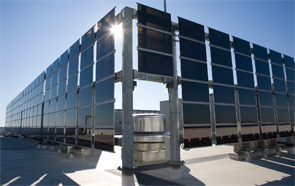

An estimated $200 billion will be spent on new hospital construction in the U.S. in the next decade, according to the U.S. Department of Health and Human Services. Many of those new facilities will showcase innovative design elements (e.g., displaced ventilation systems, geothermal power, and green roofs) intended to conserve energy and save money.
Although starting with a clean slate might make such efforts easier and more affordable, there are steps existing hospitals can take to reduce their environmental footprint and improve their bottom line.
The best place to start is to calculate your facility’s energy performance rating, says Clark Reed, director of the Healthcare Facilities Division at the U.S. Environmental Protection Agency’s Energy Star program. The rating shows how efficient a hospital is compared with others around the nation. It’s calculated on a scale of 1 to 100, with 50 being the industry average. The calculator is available at www.energystar.gov/benchmark.
“You don’t really know what steps you need to take at your facility unless you know how your hospital compares to your peers across the country,” Reed said.
If you have access to a year’s worth of utility bills, plus some basic information about your facility—square footage, the number of licensed beds, and the number of floors in the tallest building on your campus—you can get a rating in as little as an hour.
The rating serves as a “line in the sand” that helps hospitals determine where they are, where they want to be, and what steps they must take to get there. Steps can range from capital upgrades to business arrangements with new vendors.
To simplify the process, the Energy Star program recommends a five-step solution that, if followed chronologically, often helps hospitals save up to 30% on their energy bills, Reed says.
“When you’re looking at energy bills running into the millions of dollars a year, saving 10%, 20%, or 30% of that—and saving it pretty quickly—becomes significant,” he says. “That’s money that hospitals, rather than paying out to utilities, can put back into doing the work of their mission statement.”—ML

