
The Future is Near


In other hospitals, a field trip can help. “We will take IT staff out on the wards,” Dr. Feldman explains. “Come observe the process you’re automating. When they come back, they’re very sobered.”
Dr. Misra, the Johns Hopkins intern, notes that mobile devices are perfect hosts for checklists. Their ease of use can even be viewed as a potential motivator to ensure that those checklists are completed, particularly for younger physicians who have either grown up with or started their careers with more exposure to technology than previous generations.
“The biggest strength of touchscreen technology is it’s interactive,” Dr. Misra says. “It’s fun to use, much more fun than checking off boxes on a piece of paper or on a computer screen.
“It’s portable, it’s lightweight, it’s where you are.”
Trouble Spots
The virtually limitless boundaries for touchscreen technology to replace functions in the hospitalist’s workflow is, of course, limited in one glaring respect: privacy. The security of devices, applications, or peripherals must be paramount to their effectiveness, Dr. Feldman says, adding patient information must “remain sacrosanct.”
At BIDMC, digital security is accomplished in part via a bifurcated wireless network that allows physicians access to a secure connection while simultaneously and transparently maintaining a free wireless network for patients and visitors. Not all hospitals can afford the infrastructure necessary for such a setup. And even for health systems that have separate wireless systems, the connectivity cuts both ways, says Mike Stinson, vice president of marketing for Motion in Computing, an Austin, Texas, firm that produces tablet computers for multiple industries, including healthcare.
“Are you willing to have every file on your personal system viewable and accessible by the IT guys so they can make sure you don’t have access to something you shouldn’t have access to?” Stinson asks. “It seems easy and appealing, but there are larger issues.”
Stinson says the privacy and safety concerns of the technology can be addressed. Even potential fears regarding the sterility of the equipment might be simply solved. To wit, a column in the Journal of Surgical Radiology in January found that the device worked well when put in an X-ray cassette sealed off with a hemostat.1
Dr. Nathanson, an ED physician who has worked closely with hospitalists at BIDMC in the past, says it’s clear to him that making the technology easy enough to use in a medical setting is no longer the hurdle. It’s the systemic timidity of physicians who are slow to endorse and incorporate cutting-edge technology into entrenched work patterns.
“In medicine, it tends to take a long time,” he says. “The adoption of technology in medicine can be very challenging. If nothing else, we’re very early in the process.” TH
Richard Quinn is a freelance writer based in New Jersey.
Reference
- Wodajo, FM. The iPad in the hospital and operating room. Journal of Surgical Radiology website. Available at: www.surgisphere.com/SurgRad/issues/volume-2/1-january-2011—pages-1-112/152-column-the-ipad-in-the-hospital-and-operating-room.html. Accessed Jan. 3, 2011.
The Evolution of Touchscreens
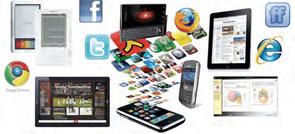
Touchscreen technology, or a device that uses its screen as the interface between the user and the computing power, debuted in the consumer world with handheld computers known as personal digital assistants—PDAs for short.
Many considered the first commercial success the Palm Pilot, which was marketed in the early 1990s and utilized a small, plastic writing utensil to manipulate the screen. Palms were functional for years, but the mass popularity of touchscreen devices did not materialize until Apple introduced the iPhone in 2007.
Last year’s debut of Apple’s iPad further popularized the technology, providing nearly all of the same pros and cons of smartphone technology but with screen sizes large enough to be used as a bedside tool. The iPad screen measures 9.7 inches on a diagonal measure, nearly three times the size of the iPhone screen.
“We have some [PC] monitors in the hospital that aren’t much bigger than the iPad,” says Dr. Feldman, “and they have the same resolution. There is no difference between my working on my iPad and my working on my desktop, with respect to the quality. … The cool thing about being a hospitalist with an iPad is I can bring my computer with me and show it to the patient.”
Although Apple has dominated the touchscreen marketplace in recent years, competitors are lining up fast. Large IT firms, including Hewlett-Packard, Motorola, and Microsoft, are looking to take a bite out of Apple’s stronghold in the arena. Market research firm Yankee Group projects tablet sales will grow to 168 million in 2014, up from 21 million in 2010.
Accordingly, engineers are developing accessories and software that will transform the devices into the next generation of medical equipment. “Largely, the health information system (HIS) firms are aligning to import for existing platforms on mobile devices,” Johnson says. “The path of least resistance is adapting those to a slate-style device.”
For now, that is.
“What I’m most impressed with is how far we’ve come from the [first] version of the device,” Dr. Nathanson says. “Imagine where this could go.”—RQ

