Efficacy of Unloader Bracing in Reducing Symptoms of Knee Osteoarthritis


Braces designed to unload the more diseased compartment of the knee have been used to provide symptomatic relief from osteoarthritis (OA). Research on the efficacy of these braces is needed.
Thirty-one patients with knee OA were randomized to receive an unloader brace (n = 16) or not to receive a brace (control group, n = 15). Knee Injury and Osteoarthritis Outcomes Score (KOOS) and visual analog scale (VAS) scores were used to evaluate outcomes.
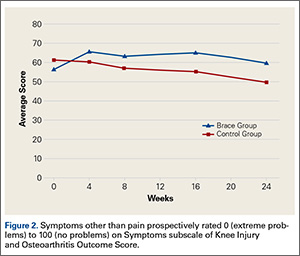
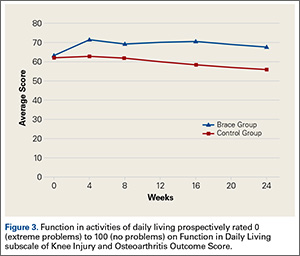
KOOS results showed that the brace group had significantly less pain (P < .001), fewer arthritis symptoms (P = .007), and better ability to engage in activities of daily living (P = .008). There was no difference in function in sport and recreation (P = .402) or in knee-related quality of life (P = .718). VAS results showed that the brace group had significantly less pain throughout the day (P = .021) and had improved activity levels (P = .035). There was no difference in ability to sleep (P = .117) or in use of nonsteroidal anti-inflammatory drugs (P = .138).
Our study results showed that use of an unloader brace for medial compartment knee OA led to significant improvements in pain, arthritis symptoms, and ability to engage in activities.
Results
Of the 50 patients randomized, 31 (16 brace, 15 control) completed the study. Of the 19 dropouts, 10 were in the brace group (4 dropped out because of brace discomfort) and 9 in the control group (5 dropped out because of significant pain and the desire for more aggressive treatment with injections). The target patient numbers based on the power analysis were not achieved because of patient enrollment difficulties resulting from the strict criteria established in the study design.
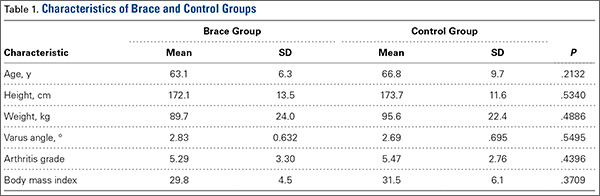
The brace group consisted of 8 men and 8 women. Braces were worn an average of 6.7 hours per day. The control group consisted of 8 men and 7 women. The groups were not significantly different in age, height, weight, body mass index, measured varus knee angle, or arthritis grade (Table 1).
Radiographs were assessed by 2 orthopedic surgeons. Varus angle measurements showed high interobserver reliability (.904, P = .03) and high intraobserver reliability (.969, P = .05); arthritis grades showed low interobserver reliability (.469, P = .59) and high intraobserver reliability (.810, P = .001).
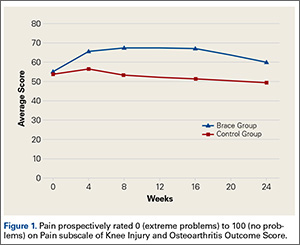
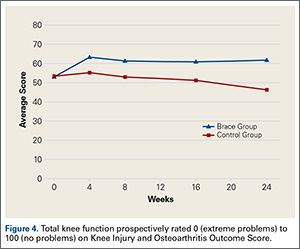
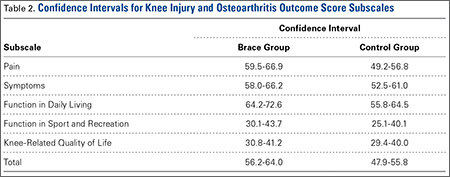
KOOS results showed that, compared with control patients, brace patients had significantly less pain (P < .001), fewer arthritis symptoms (P = .007), better ability to engage in activities of daily living (ADLs) (P = .008), and better total knee function (P = .004) (Figures 1-4). The groups did not differ in ability to engage in sport and recreation (P = .402) or in knee-related quality of life (P = .718), but each parameter showed a trend to be better in the brace group. There was no effect of time in any KOOS subscale. Confidence intervals for these data are listed in Table 2.
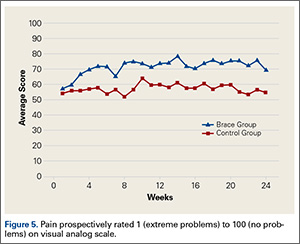
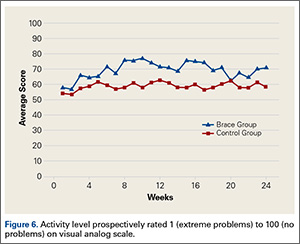
VAS results showed that, compared with control patients, brace patients had significantly less pain throughout the day (P = .021) and better activity levels (P = .035) (Figures 5, 6). The groups did not differ in ability to sleep (P = .117) or NSAID use (P = .138), but each parameter showed a trend to be better in the brace group. There was no effect of time in either VAS.