Effect of Plate in Close Proximity to Empty External-Fixation Pin Site on Long-Bone Torsional Strength


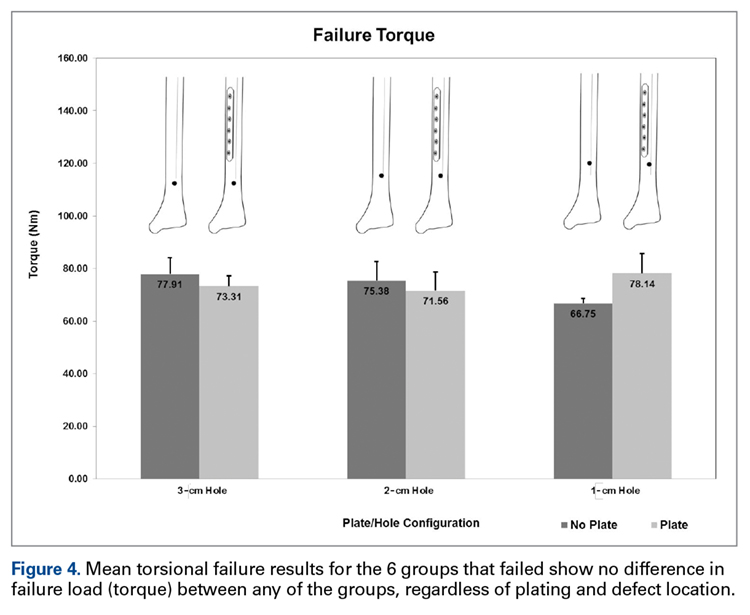
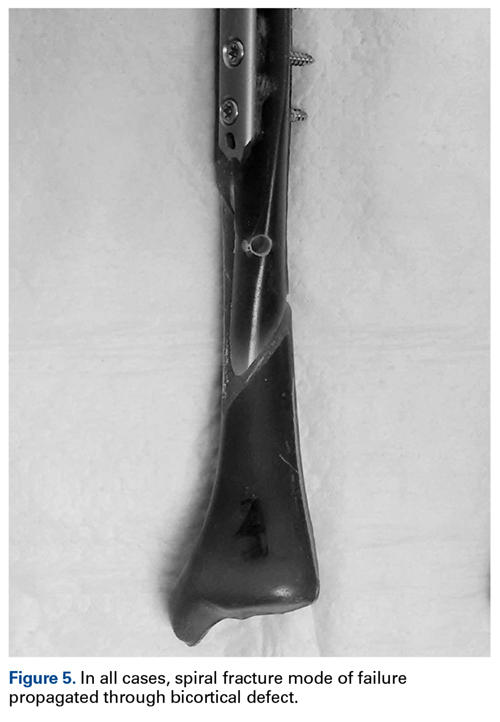
Complex tibia fractures are often provisionally stabilized with external fixation prior to definitive fracture fixation. Bicortical defects, such as those left after removal of a fixator pin, can decrease the torsional strength of long bone. Evaluating the effect of subsequent plate fixation in close proximity to a defect on the torsional strength of the tibia is the purpose of this study. Eight groups of 5 fourth-generation left composite tibias were tested to failure in torsion. The experimental plated groups consisted of bicortical defects at 3 cm, 2 cm, and 1 cm distal to the plate end, with 1 plated group without a defect. The control groups consisted of equivalent defects in the same distal longitudinal locations, without plates attached, as well as an unplated group without a defect. There were no statistical differences in torsional stiffness or failure torque between any of the groups. The mode of failure for all specimens with bicortical defects was a spiral fracture that bisected the axis of the defect. Based on the results of this composite tibia study, varying the proximity of a bicortical defect to a plate does not affect the torsional stiffness or torsional failure strength of the bone.
Take-Home Points
- The location of a bicortical defect in proximity to a tibia plate does not appear to affect the torsional stiffness or torsional failure strength of the bone.
- External fixator pin placement should be based on considerations other than the potential for creating a distal stress riser after definitive fracture management.
A stress riser in cortical bone may be considered any abrupt change in the contour or consistency of the hollow structure, such as a surface defect, that not only weakens the bone but concentrates stresses at that transition point.1 A cortical defect that is 20% of the bone diameter is associated with a 34% decrease in torsional strength, thus representing a “stress riser.”2 High-energy and complex tibia fractures are often provisionally stabilized with external fixation that gives the soft tissues time to recover before definitive fracture fixation. Pin diameter for a medium-size tibia external fixator typically is 5.0 mm, resulting in a 10-mm defect in bicortical placement. Therefore, any tibia with a diameter of <50 mm is at risk for a stress riser fracture.
Although it had been established that sizable cortical defects can decrease the torsional strength of long bone,2 the effect of a plate in close proximity to a defect secondary to an empty external-fixator pin site on torsional strength has not been determined. We conducted a study to evaluate this effect. The null hypothesis was there would be no difference in tibia torsional strength attributable to varying the proximity of a tibia midshaft plate to a 5.0-mm bicortical defect.
Methods
Forty fourth-generation, medium-size left composite tibias (Pacific Research Laboratories) were divided into 8 groups of 5 bones (Figure 1). 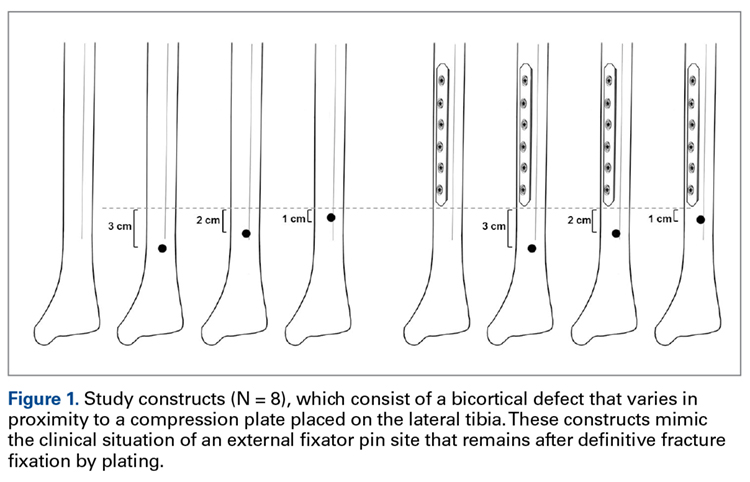
Torsion testing to failure was performed for all specimens in a manner similar to that described by Gardner and colleagues.3 Impression molds for the composite tibia constructed from polymethylmethacrylate encased the superior and distal ends, leaving 25.5 cm of exposed midshaft. This allowed the composites to be rigidly clamped into a materials testing system (858 Mini-Bionix; MTS) equipped with a 100.0-Nm torsional load cell (Figure 2).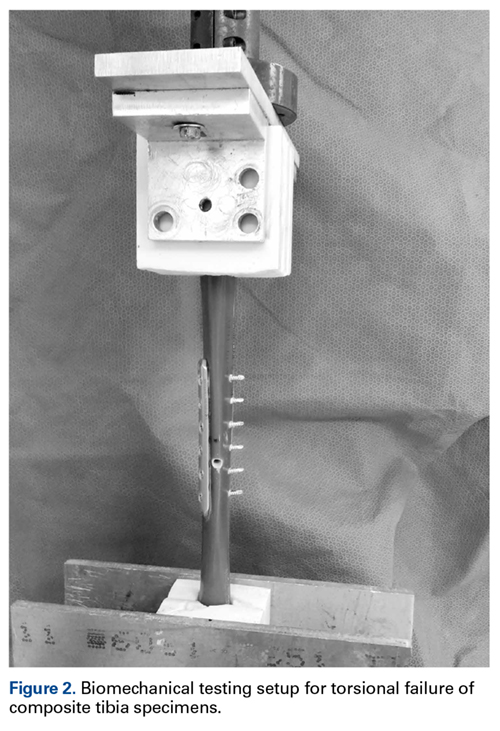
Results
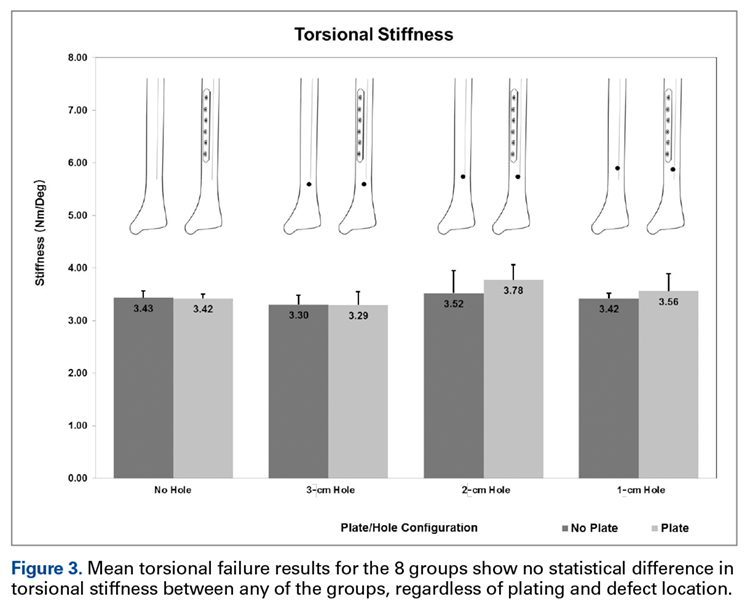
Graphical results for torsional stiffness are presented in Figure 3. R2 for all stiffness calculations was >0.99.