
Consumer-Driven Healthcare


Joseph Forrester, DO, a critical-care hospitalist and pulmonologist in Denver, discovered firsthand how scoping out and paying for healthcare now resembles shopping for other big-ticket items. Unlike purchasing and paying down a diamond ring or a 60-inch flat-screen TV, for which the final price and payment is duly noted and balances promptly adjusted, hospital billing attempted to overcharge Dr. Forrester by 500%. He already had paid $4,000 toward his 2008 out-of-pocket deductible for medical expenses and was surprised when the hospital said he would have to pay the full $5,000 deductible before he could receive care. The savvy doc went to a real-time claims adjudication tool that he uses in his own practice to show the hospital he’d already satisfied the first 80% of the $5,000 deductible.
The hospital’s billing department listened and responded.
Dr. Forrester paid the remaining $1,000 to fulfill his deductible, and his insurer covered the rest of the treatment cost. “Having access to this information allowed him to receive care immediately, without having to wait weeks for the hospital to correct its mistaken information,” says Chris Stanley, MD, a medical director with United Healthcare.
High-deductible health plans (HDHPs) like Dr. Forrester’s have been growing in popularity since the establishment of health savings accounts (HSAs). Designed to help individuals save for future medical and retiree health expenses on a tax-free basis, HSAs were signed into law by President Bush in December 2003. These products are just beginning to influence how hospitals collect fees and how patients negotiate with their physicians—including hospitalists—about which medications, tests, and procedures they’re willing to pay for.
Break from Tradition
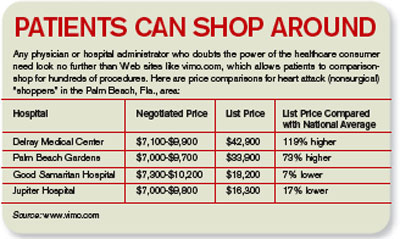
According to the U.S. Treasury Department Web site, HSAs allow individuals to “own and control the money in your HSA. Decisions on how to spend the money are made by the consumer without relying on a third party or a health insurer. Consumers will also decide what types of investments to make with the money in the account in order to make it grow.”
HSAs only are available to individuals covered solely through an HDHP. Individuals receiving veterans benefits or already on Medicare are not eligible; however, if they establish an HSA before enrolling in Medicare, they can keep it—but not add to it.
HDHPs offer consumers—especially young, healthy individuals—low premiums and high deductibles (between $1,150 and $2,900 for individuals and $2,300 to $5,800 for family plans). In addition to paying a low premium, consumers can put money into an HSA to pay for out-of-pocket expenses, including deductibles, co-pays, and co-insurance. The maximum amount of tax-free money a consumer can stash in an HSA this year is $5,800 for individuals and $11,600 for families. (Those 55 and older can contribute an additional $1,000 annually to their HSAs to accelerate their savings rates.)

