
Back to Basics


Dr. Wachter convened a Department of Hospital Medicine case conference discussion of a real patient. He also led a simulated root cause analysis discussion of an actual medical error, which occurred at UCSF when the wrong patient was given an unnecessary cardiovascular physiology procedure scheduled for a different patient with a similar sounding name. Organized discussion of medical errors, led by UCSF hospitalists, take place weekly at the medical center.
In a hands-on procedure workshop in the library, Diane Sliwka, MD, who developed the hospitalist procedure service at UCSF, introduced the clinical benefits of using ultrasound diagnostic imaging to guide routine central line placements, paracentesis, and thoracentesis in hospitalized patients. She reviewed the basics of frequency, contrast, and sterile technique with ultrasound, and the visual and spatial orientation necessary to interpret the image on the screen. Participants used the equipment to locate pockets of ascites in the abdomen of a UCSF patient and frequent training volunteer known to have pleural effusions. Participants also practiced needle insertion technique with actual hospital equipment on prepared chicken carcasses.
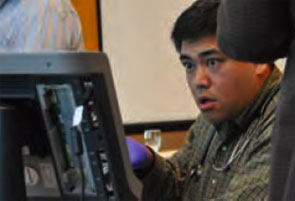
“Ultrasound does enhance the safety of bedside procedures. Ultrasound basics are learnable with practice and give a new dimension of ‘sight’ to common bedside procedures,” Dr. Sliwka explained to the participants, 70% of whom had not used ultrasound for bedside procedures. “Where it’s available, you can learn to do it with a bit of practice.”
Attendee Moira Ogden, MD, hospitalist at Terrebonne General Medical Center in Houma, La., is interested in bringing ultrasound-guided procedures into her practice, although she fears access to the equipment may not be easy to obtain. “I want to start using them; I just need to know the cost,” she says.
Mini-college Motives
“We’ve been at it for a year with our new hospitalist program,” Dr. Ogden said. “There’s such a difference between academic medicine and practice in the community. In my hospital, it’s very busy, although we’ve really just scratched the surface. It’s hard to keep up with the literature, and when I saw the flyer for this course, it looked so in-depth—almost like a re-introduction to hospital medicine.”
“Part of it was just plain curiosity—what is this going to be about? What do they see as blind spots for hospitalists in their day-to-day jobs?” asks Dr. Zachary, a six-year hospitalist, discussing his interest in attending the UCSF mini-college. “For the most part, my sense of the gaps has been dead-on.”
San Francisco Souvenirs
Participants in the UCSF mini-college received hands-on training and nuggets of new information. Here are some snippets of what they took home from the three-day course:
The clinical reasoning session with Dr. Dhaliwal was exceptional and very unique. To spend time with someone like that makes for a special experience. The preoperative evaluation review of where the evidence stands with practice management decisions we often see in the hospital was also helpful. From a career standpoint, the knowledge covered here is very applicable and very high yield.
—Kevin Leary, MD, internal medicine faculty, Walter Reed Army Medical Center, Washington, D.C.
The hands-on experience. Best was the neurology—how you do a quick neurologic exam on a hospitalized patient? The procedures workshop was also invaluable. Vascular access is the procedure I do most often, and if my hospital provides the ultrasound monitor, I’ll start using it. … I thought this course would be a great refresher for me, four years out of residency. It was not only a refresher, it’s an inspiration. We all want to be the best at what we do.
—Leslie Copeland, MD, hospitalist, St. Tammany Parish Hospital, Covington, La.
I thought the ultrasound laboratory was a lot of fun, which I’ll bring back to my institution. I’m sort of old school in how I place my lines, but we do have two ultrasound machines in the hospital, one on the units and one in the emergency department where they’re most likely to be used. It takes a little more preparation and time to use ultrasound, but it clearly benefits the patient.
— Marcus Zachary, MD, group leader, Cogent Healthcare of California, St. Francis Memorial Hospital, San Francisco
What I liked best were the small sessions. They were really informative. Also, the pearls, such as neurological physical exams that don’t take 30 minutes, and the signs of upper motor neuron disease. We often get calls from the emergency department for patients who are reporting weakness, asking if they should be admitted. You are trained to deal with that, but this was about how to do it in the real world.
—Reina Rodriguez, MD, hospitalist, Summit Medical Center, Oakland, Calif.
At my hospital, we don’t have intensivists. So there’s not a lot of structure for critical care. I was interested in seeing the studies about sepsis and the emphasis on washing teeth twice a day in the ICU. I was also interested in the discussion about how not to just plateau in your career. I’ve never been average my whole life. I don’t want to be an average physician, and that’s why I came to this course.
—Moira Ogden, MD, hospitalist, Terrebonne General Medical Center, Houma, La.

