
Allografts for Ligament Reconstruction: Where Are We Now?


The use of musculoskeletal allografts by orthopedic surgeons continues to rise. The process of procuring and sterilizing allografts is evolving with much consideration to limiting the spread of infectious diseases and preserving tissue integrity. Research involving the application of allografts, particularly for ligament repair, is quite active, necessitating an update for the practicing orthopedist. Avoiding donor site morbidities is one of the most commonly cited advantages of allografts over autografts. There is controversy amongst studies for allografts in terms of their biological incorporation and clinical outcomes compared to autografts. This article focuses on reviewing the most current literature and usage of allograft tissue for ligamentous reconstruction amongst orthopedic surgeons today. It includes an in-depth analysis of the current processing, handling, and safety standards employed today, in addition to the advantages and disadvantages of allograft use.
Discussion
Musculoskeletal allografts are gaining popularity for ligamentous reconstruction as their safety and efficacy continue to improve. With the great majority of tissue banks being accredited by the AATB and specific regulations such as NAT screening becoming common practice, infection rates and transmission of diseases have become incredibly rare. However, a thorough consideration needs to be taken into account when choosing between autograft and allograft on a case-by-case basis (Table). 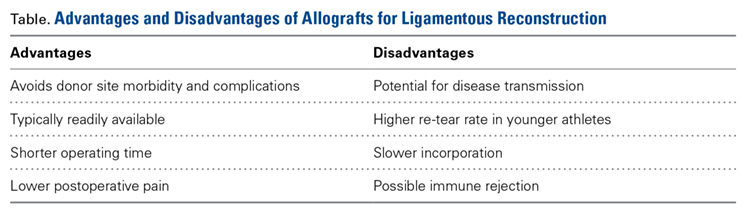
Am J Orthop. 2016;45(7):446-453. Copyright Frontline Medical Communications Inc. 2016. All rights reserved.


