
Stand by me! Reducing the risk of injurious falls in older adults


ABSTRACTAbout one-third of community-dwelling adults age 65 and older fall each year, and some suffer fractures, traumatic brain injury, and even death. Therefore, it is important to identify older adults at risk and recommend helpful interventions.
KEY POINTS
- Practitioners can reduce fall-related injury by screening older adults yearly with questions about problems with balance and gait, performing a focused history and examination when necessary, and implementing evidence-based interventions.
- Cognitive impairment itself is an independent predictor of falls because it can reduce processing speed and impair executive function.
- An exercise program with resistance, balance, and gait training is usually prescribed to patients at high risk, along with a home assessment and withdrawal or minimization of psychoactive and antipsychotic medications.
- Combined calcium and vitamin D supplements should be given to most older adults in long-term care facilities to reduce fracture rates.
- There are no specific evidence-based recommendations for fall prevention in community-living older adults with cognitive impairment or dementia.
WHAT ARE THE EVIDENCE-BASED INTERVENTIONS?
In general, interventions are chosen according to the risks identified by the assessment; multiple interventions are usually necessary. It is ineffective to identify risk factors without providing intervention.25
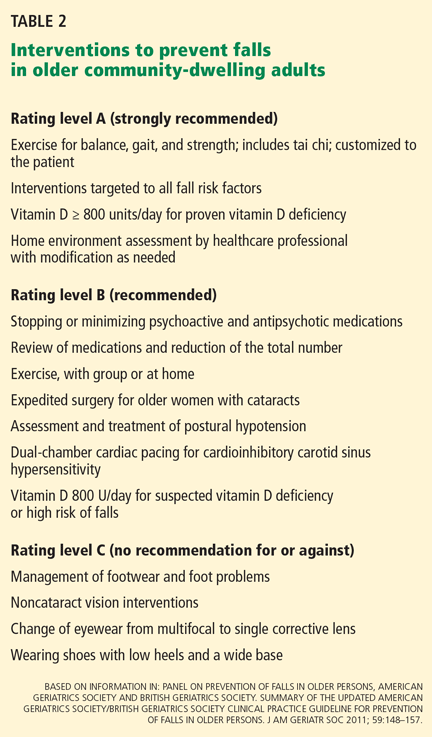
Specific interventions with recommendation levels A and B are listed in Table 2.7 Level A interventions are specifically supported by strong evidence and should be recommended. Of note, although vitamin D3 may not be bioequivalent to vitamin D2, studies in older adults have not consistently found a clinically different outcome, and either may be supplemented in the community-dwelling elderly. Except for vitamin D, these interventions target community-dwelling older adults who are cognitively intact.
Home assessments are effective in high-risk patients, such as those with poor vision and those who were recently hospitalized. The goal is to improve safety, particularly during patient transfers, with education and training provided by an occupational or physical therapist or other geriatric specialist. The benefit of home assessment and environmental modification is greater when combined with other strategies and in general should not be implemented alone.
Exercise is an important intervention. The number needed to treat (NNT) to prevent one fall in older people over the course of at least 12 weeks is 16.26 This compares favorably with interventions that are commonly used in the general population, such as aspirin therapy as secondary prevention for cardiovascular disease (NNT for 1 year = 50)27 and statin therapy to prevent one death from a cardiovascular event over 5 years in people with known heart disease (NNT = 83).28
Exercise recommendations should be customized to the patient. The amount and type of exercise depends on the patient’s baseline physical activity, medication use including antiplatelet and anticoagulant therapy, home environment, cardiac and pulmonary reserve, vision and hearing deficits, and comorbidities including neuropathy and arthritis.
The well-known risks associated with exercise include myocardial infarction and cardiac arrest, as well as falls and fractures. However, the benefits extend beyond fall risk and include improvements in physical function, glycemic control, cardiopulmonary reserve, bone density, arthritic pain, mood, and cognition. Exercise can also help manage weight, reduce sarcopenia, and increase opportunities for socialization. In most positive trials, the exercise interventions lasted longer than 12 weeks, had variable intensity, and occurred 1 to 3 times per week.
The American College of Sports Medicine recommends that older adults perform aerobic exercise 3 to 5 times per week, 20 to 60 minutes per session (the lower ranges are for frail elderly patients).29 It also recommends resistance training 2 to 4 days per week, 20 to 45 minutes per session, depending on the patient’s level of frailty and conditioning.30 Most older adults do not exercise enough.
Interventions listed at the bottom of Table 2 do not, in general, have enough evidence to support or discourage their use; these are level C recommendations. However, these interventions may be considered for certain individuals. For example, older adults with diabetic neuropathy are often unaware of their foot position when they walk. Additionally, those with diabetic neuropathy may have slower generation of ankle and knee strength compared with age-matched controls. These patients may benefit from targeted physical therapy to strengthen ankle and knee extensors and to retrain stride and speed to improve both gait and safety awareness.
Patients who wear shoes that fit poorly, have high heels, or are not laced or buckled have a higher risk of falls.31 Consider recommending footwear that has a firm, low, rubber heel and a sole with a large surface contact area, which may help reduce the risk of falling.32 Advise patients to wear shoes when they are at home and to avoid using slippers and going barefoot.33
Cataract surgery, another level C intervention, is associated with fewer fall-related injuries, particularly hip fracture.34 Noncataract vision interventions (such as exchanging progressive or bifocal lenses for single-lens glasses) may be effective in select patients if distorted vision in the lower fields of view increases the risk of falling, particularly outdoors.35
INTERVENTIONS FOR SPECIAL POPULATIONS
Falls occur more frequently in mobile residents of long-term care facilities than in community-dwelling adults.7 Institutional residents are older and more frail, have more cognitive impairment, and are prescribed more medications. Half of long-term care residents fall at least once a year.7
The data support giving combined calcium and vitamin D supplementation to older adults in long-term care facilities to reduce fracture rates.36 The NNT to prevent one hip fracture is about 111.37 Hip protectors in this setting may reduce the risk of a hip fracture but also may increase the risk of a pelvic fracture. They do not alter the risk of falling.38
Collaborative interventions can help reduce the fall risk in older adults in the nursing home.39 Input from medical, psychosocial, nursing, podiatric, dietary, and therapy services can be solicited and incorporated into an individualized fall prevention program. The program can also include modifications in the environment to improve safety and reduce fall risk.
The benefits of exercise in reducing injurious falls in long-term care is less clear than in the community, likely because of the heterogeneity of both the long-term care population and the studied interventions. Exercise has other benefits, however. It maintains a person’s ability to complete ADLs, improves mood, reduces hyperglycemia, and improves quality of life. Some studies have found a greater risk of falling with exercise therapy as independence increased.40 However, a meta-analysis in 2013 found that exercise interventions, ranging from 3 to 24 months and consisting mainly of balance and resistance training, reduced the risk of falls by 23%.41 Mixing several types of exercises was helpful. Studies of a longer duration with exercise sessions at least 2 to 3 times per week demonstrated the most benefit.41 There was no statistically significant reduction in fracture risk in this meta-analysis,41 although, possibly, more participants would have been needed for a longer period to demonstrate a benefit. Additionally, no study combined osteoporosis treatment with exercise interventions.
WHAT EVIDENCE EXISTS FOR PATIENTS WITH COGNITIVE IMPAIRMENT?
Currently, there are no specific evidence-based recommendations for fall prevention in community-dwelling older adults with cognitive impairment and dementia.7 Cognitively impaired adults are typically excluded from community studies of fall prevention. The one study that specifically investigated community-dwelling adults with cognitive impairment was not able to demonstrate a fall reduction with multifactorial intervention.42
PREVENTING FALLS IN ELDERLY PATIENTS WHO RECENTLY HAD A STROKE
Falls are common in patients who have had a cerebrovascular event. Up to 7% of patients fall in the first week after a stroke. In the year after a stroke, 55% to 75% of patients experience a fall.43 Falls account for the most common medical complication after a stroke.44
Several small studies found that vitamin D supplementation after a stroke reduced both the rate of falls and the number of people who fall.45 Additional interventions such as exercise, medication, and visual aids have been studied, but there is little evidence to support their use. Mobile patients who have lower-extremity hemiparesis after a stroke may develop osteoporosis in the affected limb, so evaluation and appropriate pharmacologic therapy may be considered.


