
The role of adjuvant chemotherapy in early-stage and locally advanced non–small cell lung cancer


ABSTRACTAdjuvant chemotherapy benefits only a small proportion of patients in the setting of resected early-stage non–small cell lung cancer, and in unselected patients, any benefit is modest. Analysis of clinical trials of adjuvant chemotherapy revealed that differential expression of DNA repair proteins and a 15-gene expression profile affected outcomes with treatment. Biomarkers and gene expression profiles are now being studied in prospective clinical trials to gauge their value in selection of adjuvant therapy and individualization of therapy.
GENE EXPRESSION PROFILING
Gene expression profiles, already used to predict benefit from chemotherapy in early-stage breast cancer, may inform treatment decisions in lung cancer as well. A15-gene signature that could predict risk of recurrence and death after surgery alone for stage Ib or II NSCLC was identified using fresh frozen tissue of patients from the National Cancer Institute of Canada (NCIC) Clinical Trials Group (CTG) JBR.10 trial of vinorelbine/cisplatin.9 The risk profile was subsequently validated with reverse transcriptase-quantitative polymerase chain reaction (RT-qPCR) in the same cases and in four independent sets of patients.9
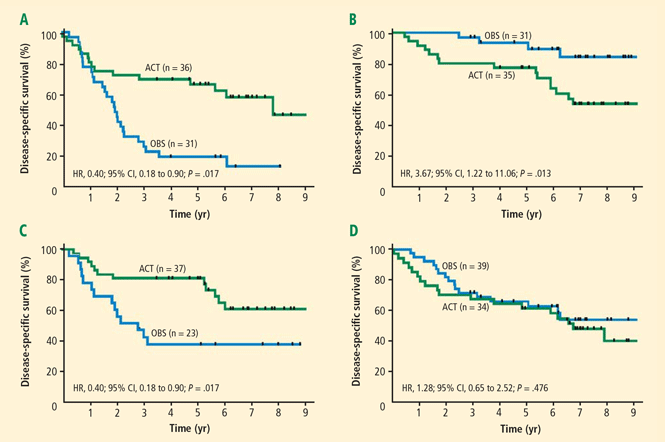
Among those patients with stage Ib disease, the gene expression profile was both prognostic (HR of 13.22 for disease-specific survival in the high- vs low-risk population) and predictive (HR of 0.44 for the use of adjuvant chemotherapy in the high-risk patients but no survival benefit observed with chemotherapy in low-risk patients).9
USE OF BIOMARKERS TO SELECT TREATMENT
As alluded to earlier, the use of biomarker expression to guide treatment selection is an area of intense investigation. In the metastatic setting, therapy targeted to the EGFR mutation has proven to be remarkably beneficial in patients with EGFR-activating mutations. In the adjuvant setting, the NCIC CTG BR.19 trial enrolled an unselected population of patients with completely resected stage Ib to IIIa NSCLC; the patients were randomized to 2 years of treatment with the tyrosine kinase inhibitor gefitinib, which targets EGFR, or placebo. Tissue samples from trial participants were collected and revealed KRAS mutation in 27%, a high EGFR gene copy number by fluorescence in situ hybridization (FISH) in 41%, and an activating EGFR mutation in 21%.
The NCIC CTG BR.19 trial was greatly underpowered because enrollment was stopped at 503 patients when, in 2008, the SWOG 0023 investigators reported a worse overall median survival with maintenance gefitinib after definitive chemoradiation in patients with stage III NSCLC.10 As a result of the early termination of patient accrual, the median duration of adjuvant gefitinib in NCIC CTG BR.19 was less than 5 months. Further, only 20% were exposed to chemotherapy and only 21% of the final study population had an EGFR mutation. In the overall study population, the HR for overall survival among gefitinib recipients was 1.23, indicating harm, and there was a trend in favor of placebo on the end point of disease-free survival. Neither KRAS nor EGFR copy number was predictive or prognostic, and EGFR mutation status was not prognostic.11 Patients with wild-type EGFR had a trend toward detriment with maintenance gefitinib that was similar to that of the overall population, and those with EGFR mutation experienced no benefit with maintenance gefitinib.
In the Randomized Double-Blind Trial in Adjuvant NSCLC with Tarceva (RADIANT), patients with resected stage I to IIIa NSCLC, with the option for postoperative chemotherapy, were assessed for EGFR expression by immunohistochemistry or FISH and then randomized to erlotinib or placebo for 2 years. The trial completed accrual in 2010 and results are expected in 4 to 5 years.
Cleveland Clinic is currently accruing patients for a phase 2 trial of patients with resected stage I to IIIa NSCLC. All patients will have their tumors screened for activating EGFR mutations; those with activating mutations will receive adjuvant erlotinib for 2 years. starting within 6 months of surgery.
SUMMARY
Although adjuvant chemotherapy has been well established for patients with early-stage NSCLC, stage alone is not an ideal biomarker to predict the utility of chemotherapy, as the vast majority of patients derive no benefit from chemotherapy.
Biomarkers have been poorly validated and therefore are inappropriate for clinical use at this time. Validation of gene arrays has been disappointingly slow in lung cancer because of the absence of large tumor banks that are available in breast cancer and colon cancer.
It remains unclear whether targeted therapies improve outcomes over traditional chemotherapy in the adjuvant setting in NSCLC, as tumors in the metastatic and adjuvant settings are not the same.


