
Type D personality and vulnerability to adverse outcomes in heart disease


ABSTRACTGeneral distress, shared across depression, anxiety and anger, partly accounts for the link between mind and heart. The type D (distressed) personality profile identifies individuals who are particularly vulnerable to the adverse effect of general distress. Type D individuals frequently experience negative emotions and are socially inhibited. This profile is more stable than that associated with episodes of clinical depression and describes the chronic nature of distress in some patients. Type D may also partly account for the effect of emotional distress on cardiac prognosis. Type D is associated with a threefold increased risk of adverse cardiovascular outcomes, even after adjustment for depression. This relationship is less obvious in patients with heart failure. Plausible pathways linking type D to cardiovascular complications include hypothalamic-pituitary-adrenal–axis hyperreactivity, autonomic and inflammatory dysregulation, and increased oxidative stress. Research needs to further clarify these pathways and investigate whether type D patients may benefit from closer monitoring of risk factors and a personalized approach to behavioral intervention. The DS14 is a brief, well-validated measure of type D that could be incorporated into clinical research and practice to identify high-risk patients.
BIOLOGIC PATHWAYS OF TYPE D
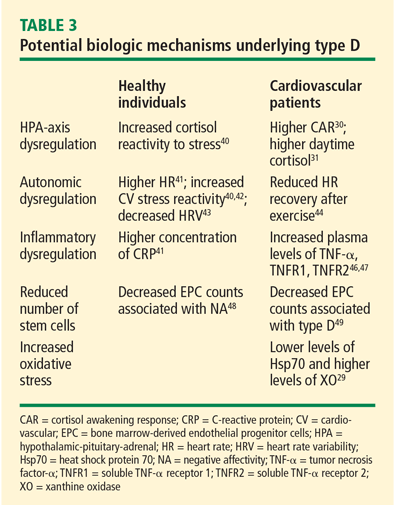
Other studies found that type D was associated with inflammatory dysregulation. In healthy adults, type D has been related to higher concentrations of C-reactive protein.41 In heart failure patients, type D is associated with increased plasma levels of the proinflammatory cytokine tumor necrosis factor (TNF)-α and its soluble receptors 1 and 2.46,47 Increased TNF-α levels may cause suppression of bone-marrow–derived endothelial progenitor cells (EPCs) that play an important role in maintaining vascular integrity. The negative affectivity component of type D has been shown to predict decreased circulating EPC counts in healthy individuals48; another study found that these EPC numbers were reduced by more than 50% in heart failure patients with a type D personality.49 Type D personality is also associated with an increased oxidative stress burden in patients with chronic heart failure.29 Studies on genetic linkage50 and heritability51 further support biologic underpinnings of the type D construct.
Regarding pathways that may explain the effect of type D, some issues are of special interest. First, genetic factors contribute to stability in type D personality, but environmental factors may induce changes in type D characteristics over time.51 Hence, given this role of environmental influences over time, behavioral intervention would be feasible and useful in type D patients. Second, type D can promote heart disease indirectly through behavioral pathways. Type D has been associated with a sedentary lifestyle,41,52 an unhealthy diet,53 and a passive coping style.54,55 Poor adherence to medical treatment56,57 and reluctance to consult clinical staff58 may jeopardize the working relationship with type D patients in clinical care. Intervention may focus on the management of these behavioral risk factors in type D patients. Third, many of these biologic40–43,48,50,51 and behavioral41,52–54 pathways have also been documented in healthy type D individuals, which suggests that these associations cannot be explained away by the confounding effect of underlying cardiovascular disease.
CLINICAL IMPLICATIONS OF TYPE D
The findings from type D research have a number of clinical implications. Type D is associated with an increased risk of adverse events,23 chronic distress,35–38 and suicidal ideation.59 Type D may also have an adverse effect on the outcome of invasive treatment.14,19,21,22,24,26,60
Type D was associated with mortality and morbidity at 9 months14 and 2 years24 following coronary artery stenting, and with impaired health status 1 year following bypass surgery.26 Type D also predicted mortality and allograft rejection following heart transplantation,19 and an increased risk of ventricular arrhythmia21 and mortality22 in ICD patients. Researchers from the Cleveland Clinic have shown that type D is a risk factor for anxiety in ICD patients.60
Regarding the DSM-IV classification by the American Psychiatric Association,61 type D qualifies for the diagnosis “psychological factors affecting medical condition” (Section 316). In keeping with this classification, the diagnostic category type D affects (1) the course of cardiovascular conditions,23 (2) the treatment of these conditions,56,57 and (3) the working relationship with medical staff.58 At present, no clinical trial has examined whether intervention for distress among type D patients alters their risk for adverse events. Nevertheless, some have argued that it is plausible for type D patients to learn new strategies to reduce their level of general distress.62 Previous research with patients experiencing symptoms like those of type D patients suggests that psychotherapy, social skills training, stress management, and relaxation training may reduce stress in these patients and improve their ability to express their emotions to others.62 Others have suggested that stress management training, including communication skills and problem-solving, may further improve the risk profile and health in cardiac patients.63
It is possible that type D patients may benefit from close monitoring of their clinical condition and from aggressive management of their risk factor profile to prevent adverse clinical events. Cardiac rehabilitation is an effective approach to treating risk factors and enhancing well-being in CAD.63,64 A few studies have examined the effect of cardiac rehabilitation in type D patients. One study found a significant decrease in the social inhibition component of type D following cardiac rehabilitation, but there was no change in the prevalence of type D at 1-year follow-up.65 Although the type D profile tends to remain stable during rehabilitation,65,66 evidence shows that type D patients who participate in cardiac rehabilitation improve in physical and mental health status.66 Cardiac rehabilitation may also ward off further deterioration in negative affect,67 which, in turn, has been associated with better survival in patients who participated in rehabilitation.68 Future studies need to examine the effect of cardiac rehabilitation and other personalized approaches to treatment in type D patients.
CONCLUSIONS
General distress shared across negative emotions6,23 may partly account for the role of depression, anxiety, and anger in cardiovascular disorders.1–5 Some cardiac patients are more likely to experience distress than others. Type D may identify these psychologically vulnerable patients who tend to experience general distress.23 This propensity to general distress differs from depression, predicts adverse outcomes, is linked to plausible biologic pathways, and highlights the chronic nature of psychologic distress in some cardiac patients.
After adjustment for depression, type D remains significantly associated with an increased risk of adverse events in patients with CAD.16,24,25 However, this association is less obvious in patients with heart failure, and type D did not predict survival in one heart failure study.20 Although initial findings suggest a number of plausible biologic and behavioral pathways, more research is needed to explain the adverse effect of type D on cardiovascular outcomes. Future research also needs to investigate whether type D patients may benefit from close monitoring of their risk factors and a more personalized approach to behavioral and cardiac treatment.
Overall, the current understanding of type D indicates that general distress should not be ignored in the link between mind and heart, and that cardiovascular patients who have a type D personality profile are particularly vulnerable to the adverse clinical effects of general distress. The DS1410 is a brief, well-validated measure of type D that could be incorporated into clinical research and practice to identify patients who are at risk of chronic distress and poor prognosis.


