
Redesigning the neurocritical care unit to enhance family participation and improve outcomes


ABSTRACT
Emory University Hospital recently converted its neurocritical care unit into an environment that enhances involvement of the patient’s family. Each patient room now has an adjacent family area with comfortable accommodations for daytime and nighttime use. The new unit design, which drew from evidence on the impact of the physical environment on patient outcomes, facilitates better interactions between families and the medical team, and early studies show that patient satisfaction and staff satisfaction have increased. This article describes the impetus for and process of the unit redesign, as well as initial results and lessons learned.
DESIGN PROCESS WAS DYNAMIC
To help determine factors such as patient room size and configuration as well as the design of family spaces, we analyzed best practices of the prior 10 years’ winners of the ICU Design Citation Award, which is given jointly by the Society of Critical Care Medicine, the American Association of Critical Care Nurses, and the American Institute of Architects Academy on Architecture for Health. We partnered with the division of health care design at Georgia Institute of Technology’s College of Architecture as well as with a psychologist specializing in the role of the physical environment and with numerous graduate students. Several architectural design brainstorming meetings were held.
We then created a simulation that consisted of a large mock-up of the proposed ICU, including a nurses’ station, patient rooms, booms, and family areas. We spent an entire day role-playing a variety of procedures, including resuscitation, intubation, implantation of a brain monitor, handoffs with nurses inside and outside the room, and interactions between families and staff. Videographers recorded everything for later analysis.
We changed designs as we learned from such experiences. We originally planned to distribute the nurses’ stations throughout the ICU but later decided to keep a communal area as well, recognizing that nurses and doctors like to be with each other and need to support one another.
About 50 family members of patients who had graduated from or were still in the critical care unit were involved with the unit’s design throughout the process.
PROPOSAL BECOMES REALITY
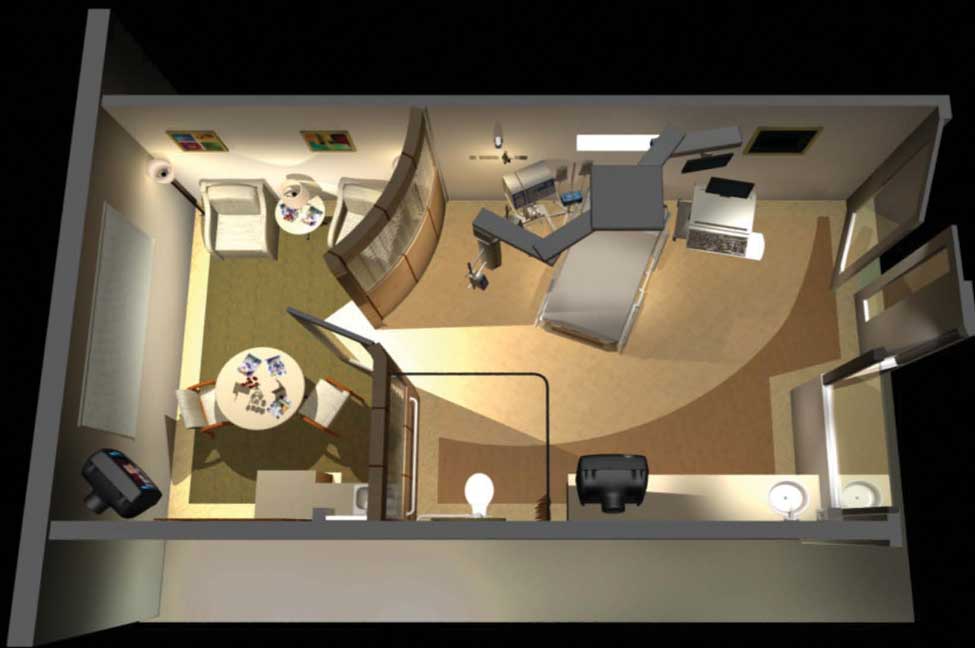
The new unit allows us to do things we could not do before. I can now easily hold a private conversation with a family member when I visit a patient. Family members can leave the room for some respite and still be just a stone’s throw away from their loved one.
Patient rooms are much bigger than before, and the booms lift a lot of equipment off the floor. The beds and doors are configured so that patients who are awake have a direct line of sight to the nurse’s station.
MEDIA ATTENTION AND REACTIONS
Our new unit was featured in both an article2 and a health care blog3 by the Wall Street Journal. The article opened as follows: “For decades, hospitals tried to keep visitors out of intensive-care units for more than a few minutes at a time. This year, Emory University Hospital here went the other way: It began inviting family members to move into the ward and take a hand in the patient’s care.”2 I think the reporter captured the key idea well, but I would change the word “visitors” to “participants” to indicate that patients’ family members really have a degree of responsibility.
There were interesting comments from readers in response to the article. Many were positive, but not everyone felt the changes were a good idea. One reader wrote, “Pandering to a half-dozen relatives is rarely beneficial to anyone. When we realize that hospitals are there to heal and not to entertain, we’ll cut down the excess costs of treating critical care patients. A close relative is entitled to know what’s happening on a timely basis. Any involvement beyond that should be limited to what is medically beneficial to the patient.”
Another comment, probably from someone who works in an ICU, was, “This sounds more like a marketing ploy by hospital administrators than a plan developed by the nurses and physicians in the trenches.” Interestingly, administrators at Emory resisted the changes because of the high expense. Although the tone of this comment seems cynical, the writer brings up a valid danger—that limited health care resources potentially could be diverted from the patient to the family. But although care that fosters family participation costs more money and takes more energy, what matters is that we are doing a better job for patients and their families.
BENEFITS OF FAMILY-CENTERED UNITS: A CASE STUDY
The following case study illustrates some of the advantages of our new family-centered unit.
David was a 31-year-old computer programmer, the father of a 3-year-old girl, and about to be married. He came in with a grade 3 subarachnoid hemorrhage from a severe carotid intracranial aneurysm. He was in the old neurocritical care unit for 4 or 5 days, and then was moved to the new unit when it opened.
The family—David’s parents and his fiancée— kept a rotating vigil. The Wall Street Journal article described how they always felt that they were in the way in the old ICU, whereas they felt welcome in the new facility. The family often stood at David’s bedside as the team explained the purpose of the complex monitors and instruments. The mother said, “This was our home for a month, and it got so that the nurses could tell when we needed a hug.”2
After 2 weeks, David developed neurogenic pulmonary edema, severe pneumonia, acute respiratory distress syndrome, and heart failure. We induced a coma to protect his brain from high intracranial pressure and placed hypothermia catheters to lower his core temperature in an attempt to better oxygenate him. Just as he was getting better, the aneurysm ruptured again, and we knew that recovery was hopeless.
The family was by his bedside 24 hours a day and knew that the medical team was as well. They witnessed the whole situation and understood when we ran out of options. As David’s parents and fiancée gathered at the bedside, I told them that David had progressed to brain death. Shortly after that, the team that arranged organ donation came to speak with David’s parents, and they elected to donate. They were grateful for the time they had with him and for the way they were treated. David’s father said, “No one ever misled us or told us anything but the truth…and most importantly, we were there for everything.”2
We did everything we could for David, and nothing could change his ultimate outcome. But I think that the way someone dies is incredibly important. The circumstances of how he was treated probably helped allow the family to donate David’s organs and better come to terms with his death. They later generously donated their time to help the neurocritical care unit develop the family-centered approach we wanted by participating in many discussions about their experiences.


