
Breaking the cycle of medication overuse headache


ABSTRACTWhen patients who have frequent, disabling migraines take medications to relieve their symptoms, they run the risk that the attacks will increase in frequency to daily or near-daily as a rebound effect comes into play. This pattern, called medication overuse headache, is more likely to happen with butalbital and opioids than with migraine-specific drugs, as partial responses lead to recurrence, repeat dosing, and, eventually, overuse. Breaking the cycle involves weaning the patient from the overused medications, setting up a preventive regimen, and setting strict limits on the use of medications to relieve acute symptoms.
KEY POINTS
- Medication overuse headache can occur with as few as 5 days per month of treatment with butalbital or 8 days per month with opioids.
- The features vary, but the most important is headache on 15 or more days per month, lasting at least 4 hours if untreated, for at least 3 consecutive months. Other common symptoms are morning headaches, neck pain, nonrestorative sleep, and vasomotor instability, all of which tend to improve with weaning from the overused medications.
- Daily preventive treatment is indicated when patients have 10 or more headaches per month or severe disability from their attacks.
- With treatment, the prognosis for medication overuse headache is good. However, patients need close followup to prevent recidivism.
HOW MUCH MEDICATION USE IS TOO MUCH?
For an episodic migraine condition to transform into a chronic one, medications need to be taken on only a modest number of days per month: 5 to 10, depending on the type of medication.
A pivotal study3 found that butalbital combinations were most likely to cause medication overuse headache, needing to be taken on merely 5 or more days per month to cause it in migraineurs. Opioids caused it if taken 8 or more days per month, and triptans if taken 10 or more days per month. Nonsteroidal anti-inflammatory drugs (NSAIDs) actually protected against transformation to daily headache if used 5 or fewer days per month, but caused medication overuse headache if used 10 or more days per month.
Thus, there was a hierarchy of risk, with butalbital being the worst, opioids in the middle, and NSAIDs and triptans the least risky. None of the agents had to be taken daily to trigger medication overuse headache.
PREVENTION IS THE BEST TREATMENT
The best approach to medication overuse headache is to prevent it while the patient still has episodic migraine.
Outcomes are better with triptans or ergots
Undertreatment of migraine leads quickly to overuse of symptomatic medications, and from there to medication overuse headache.
Outcomes of episodic migraine are better when triptans or ergots (which are migrainespecific) are used first-line in patients with disabling migraine and no vascular contraindications. Patients who start with nonspecific treatment and step up to a more specific treatment when lower-level medications fail have less favorable outcomes in terms of migraine relief and disability time than those treated with triptans from the beginning.25
To put this in perspective, if a patient takes an acute medication, gets only partial relief (not a pain-free response) at 2 hours and then takes another pill, or gets a recurrence and takes another pill, the likelihood of prolonging an attack and using more medications goes up. If a patient takes a triptan and gets a sustained pain-free response, the attack is truncated and the medication usage reduced. Therefore, migraine-specific acute treatments are more likely to not be overused.
Daily preventive medication, if necessary
As noted above, if the number of headache days exceeds 10 per month, the likelihood of developing daily headache escalates steeply. Thus, patients with 10 or more days of headache per month should be prescribed preventive medications to be taken daily to reduce the frequency, severity, and duration of attacks. Preventive treatment may also increase the efficacy of the acute treatments.
The drugs used for preventive treatment are different than those used for acute treatment and are not likely to cause medication rebound headache. However, they are not very effective. Those that have the best evidence of efficacy are beta-blockers, tricyclic antidepressants, and anticonvulsants; calcium channel blockers and NSAIDs are also popular. This topic has been reviewed in detail elsewhere.26,27
REVERSING MEDICATION OVERUSE HEADACHE
If a patient already has medication overuse headache, the clinician is faced with the problem of weaning her or him from the overused medication while establishing a reasonable regimen of prophylaxis and acute medications with limits.
For the most part, these tasks can be accomplished in a series of clinic visits. However, some patients have such severe comorbid medical and psychiatric illnesses that outpatient treatment is impossible. For them, a day hospital or inpatient program with infusion capabilities is often useful.
Outpatient treatment of medication overuse headache
Outpatient treatment of medication overuse headache involves:
Educating patients about the genesis of the problem and reassuring them that you are not accusing them of being an addict. Most patients who develop medication overuse headache are habituated inadvertently, and this needs to be made clear, along with the overall plan and the likely prognosis.
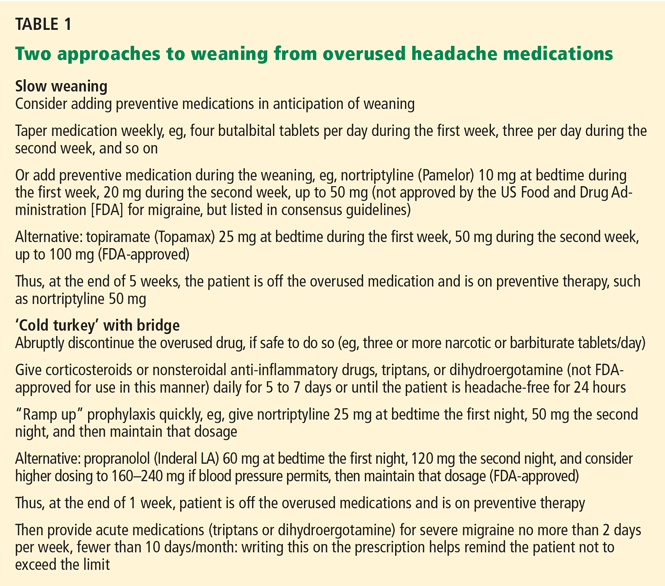
Establishing daily preventive medications. The prophylactic regimen can be established either before or during the weaning.
Providing acute medications, with limits. At a certain point in the weaning, advise the patient not to treat low-level headaches, and provide a triptan or dihydroergotamine to use for severe attacks, no more than twice weekly and less than 10 days per month. If the patient is in triptan rebound, dihydroergotamine would be the choice.
Instructing the patient to keep a headache diary to follow adherence and outcomes.
Psychology consultation can be very helpful to teach patients behavioral techniques to deal with anticipatory anxiety during the weaning.
Multidisciplinary programs with infusion capability
Some patients need a more intensive approach to restore an episodic migraine pattern. Examples: those on very high doses of narcotics or barbiturates, those with comorbid medical illnesses that limit both acute and preventive treatments, and those with severe and complicating comorbid psychiatric illnesses.
Multidisciplinary programs are available, with specialists in neurology, primary care, psychology, and physical and occupational therapy providing treatment. Patients check into the hospital or a “day hospital,” where they can also receive intravenous infusions to get through the weaning. The goal is to shift the locus of control back to patients as they revert from daily headache to episodic migraine. Patient education is crucial.
OUTCOMES ARE GOOD
There is much good news about medication overuse headache.
It can be prevented with careful monitoring of acute medication outcomes and number of headache days. Prophylaxis should be used when treating high-frequency or very disabling migraine.
Most patients improve when weaned and treated with preventive medications. “Recovery” means at least 3 months off the overused medications. In studies, more than half of patients who underwent treatment for medication overuse headache remained better and had an episodic pattern of headache 5 years later.26
Unfortunately, the initial improvement often seen with patients after weaning and being given preventive medication (72%–85% of patients improve) in the first year is often followed by preventable relapse, so it is very important to follow up with patients regularly. 28–32
Helping restore a patient’s quality of life is an outcome rewarding to primary care provider and specialist alike.


