
Clinical challenges in diagnosing and managing adult hypertension


ABSTRACTAlthough there is still no consensus on how to diagnose hypertension, opinion is moving toward incorporating out-of-office blood pressure measurements into the process. The SPRINT trial poses potential opportunities and challenges. Simplified antihypertensive drug regimens incorporating single pill combinations are very effective.
KEY POINTS
- Diagnosing hypertension continues to require a sufficient number of well-performed office blood pressure measurements for most patients.
- First-tier drug choices are angiotensin-converting enzyme inhibitors and angiotensin receptor blockers (but not both together), calcium channel blockers, and thiazide-type diuretics. Add-ons to achieve blood pressure targets should come from first-tier classes not used initially.
- Simple implementation principles can achieve high control rates across a fractured healthcare delivery landscape. Equitable care can reduce racial disparities in hypertension control.
CONTROVERSY REGARDING GOAL SYSTOLIC PRESSURE IN THE ELDERLY
JNC 8 set a systolic blood pressure target of less than 150 mm Hg in patients 60 years and older without diabetes or chronic kidney disease. This target was based on results of the Systolic Hypertension in the Elderly Program (SHEP)21 and the Systolic Hypertension in Europe (Syst-Eur) trial.22 In SHEP,21 the goal systolic pressure was individually tailored on the basis of the systolic pressure at study entry, and mean of the trial participants’ goal systolic pressure was less than 148 mm Hg, compared with less than 150 mm Hg in Syst-Eur.22 Participants in these two trials were representative of a broad spectrum of cardiovascular risk. In SHEP, 14% of the patients were black, compared with 12.6% in the US population, and both studies included patients with a history of myocardial infarction and stroke. In SHEP, 61% of the patients had a baseline electrocardiographic abnormality, and 30% of patients in Syst-Eur had a prior “cardiovascular complication.” In these randomized controlled trials, stroke, the primary end point, was reduced by 32% and 31% respectively, and major cardiovascular events were reduced by 32% and 31%, respectively.21,22
The JNC 8 panel followed a process mandated by the National Heart, Lung, and Blood Institute (NHLBI) that excluded “as-treated” or “achieved” blood pressure trials such as the Felodipine Event Reduction study (FEVER)23 because of bias due to selection of patients of inherently low cardiovascular risk who were associated with lower achieved systolic pressures. Cochrane methodologists independently arrived at the same conclusion.24 In fact, in the landmark African American Study of Kidney Disease and Hypertension (AASK), a post hoc analysis according to the blood pressure achieved indicated improved renal outcomes associated with lower achieved blood pressures—the opposite conclusion of the intention-to-treat blood pressure analysis.25 Alternative viewpoints and guidelines recommending the older goal of less than 140/90 mm Hg for elderly patients rely on observational and post hoc data, which were excluded by the National Heart, Lung, and Blood Institute process.26
As this article is prepared for publication, a press release from the NHLBI announced that the Safety and Monitoring Committee of the Systolic Blood Pressure Intervention trial (SPRINT) stopped the study early because of fewer cardiovascular complications and lower mortality in the more intensely treated group.27 SPRINT randomized more than 9,300 patients age 50 years and older with at least one additional cardiovascular disease risk factor to an intensive treatment arm targeting goal systolic pressure less than 120 mm Hg vs a standard treatment arm targeting goal systolic pressure less than 140 mm Hg. Approximately 25% of patients were age 75 years and older. Preliminary data indicate reduction of the primary composite outcome of fatal and nonfatal cardiovascular disease events by 30% and a 25% reduction in overall mortality that was homogeneous across major prespecified subgroups including those above and below age 75 years. The intensive treatment protocol was based upon combination therapy with a thiazide-type diuretic and/or an ACE inhibitor or angiotensin receptor blocker (but not both) and/or a calcium channel blocker.28
Hypertension treatment guidelines need to be based upon the results of high value randomized clinical trials and the federally funded NHLBI sponsored SHEP, ALLHAT, Action to Control Cardiovascular Risk in Diabetes (ACCORD),29 and SPRINT trials are noteworthy. Because the results of SPRINT are preliminary, updated recommendations need to await a peer reviewed publication. Important questions include the magnitude of the absolute risk reductions in SPRINT, and the apparent disparity between the ACCORD and SPRINT outcomes. ACCORD was similar in design to SPRINT, examining the same primary composite outcome and comparing goal systolic pressure less than 120 mm Hg to goal systolic pressure less than 140 mm Hg in patients with diabetes defined as glycated hemoglobin at least 7.5%. The principle finding was that there was no difference in benefit, but there was a significant increase in adverse events driven by hypotension.29
Additionally, rather than dialing in blood pressures for patients, the effect of antihypertensive treatment of large populations is to move mean population pressure and the bell shaped curve of blood pressure distribution. For example, in the southern California Kaiser Permanente hypertension population age 60 years and over, a hypertension control rate of almost 90% achieving goal blood pressure less than 140/90 mm Hg has moved the mean systolic pressure to 127 mm Hg. Almost 10% of treated patients have a last systolic pressure less than 110 mm Hg, and safety net features have been introduced to downtitrate medications for these individuals. Achieving 90% control with goal systolic pressure less than 120 mm Hg would be proportionally forecasted to move the population mean systolic pressure to 107 mm Hg, with systolic pressures in the 80s and 90s for sizable numbers of patients. Potential SPRINT implementation would require strong anticipatory safety net features. How many antihypertensive medications should be used to drive systolic pressure less than 120 mm Hg in more resistant patients? Certainly SPRINT raises important strategic population care issues.
POPULATION CARE STRATEGIES IN A FRACTURED HEALTHCARE DELIVERY SYSTEM
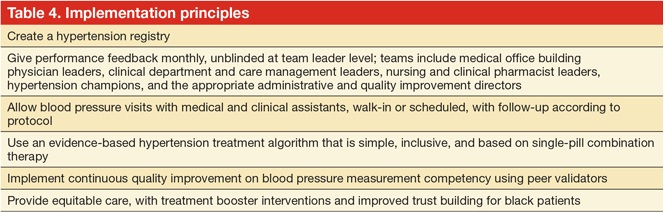
High rates of hypertension control have been achieved in large, very well-integrated healthcare systems even before widespread adoption of the electronic health record,5,30,31 and the essential implementation principles can be adapted to large and small health plans (Table 4).
A hypertension registry is necessary to generate regular performance feedback reports, and performance feedback provides factual information to drive improvement via competition and sharing of best practices. Those experienced in registry building can share their experience.5,31 Creating a hypertension registry may be as simple as identifying all patients who have an International Classification of Diseases 9 (ICD 9) code of 401.9 (essential hypertension) twice within a rolling 12-month period.
Antihypertensive drug treatment protocols should be simple, inclusive, and evidence-based. Although there are thousands of individual drug permutations of the JNC 8 treatment algorithm, ease of implementation should always be the tie-breaker. Most often, a treatment algorithm based on single-pill combination therapy will fulfill those requirements.
For example, one could start with one-half of a combination pill containing lisinopril 20 mg and hydrochlorothiazide 25 mg and then, at intervals of 2 to 4 weeks, titrate this dosage up to a full pill and then to two pills (ie, lisinopril 40 mg plus hydrochlorothiazide 50 mg) before adding amlodipine in sequentially higher doses to achieve goal blood pressure. This algorithm is inclusive for black patients, patients with stage 1, 2, or 3 chronic kidney disease, and patients with diabetes. There is good physiologic support for combination drugs, and goal blood pressure is achieved more rapidly than with sequential monotherapy.32,33 The ACCOMPLISH trial, which showed an ACE inhibitor-calcium channel blocker combination to be superior to an ACE inhibitor plus a thiazide diuretic, was not considered definitive in either the JNC 8 or European guideline reports.5,34 Implementation success supports protocol-driven algorithmic care,35 which can be practiced by physician providers, nurse practitioners, and clinical pharmacists within their scope of practice.
Given the large number of hypertensive patients, the multiple medication titration encounters necessary to attain high control rates, and the limited numbers of providers who can prescribe medication, medical and clinical assistants play a key role. The protocol-driven no-copayment walk-in or scheduled blood pressure check is an essential component of hypertension care.5,31
These principles focus on simplicity and inclusiveness and can drive high hypertension control rates nationally across a wide spectrum of healthcare plan capabilities. Health plans practicing equitable care, assigning priority and additional resources to black patients with hypertension, can close the racial performance gap.36


