
Book Review: Author offers practical advice for couples therapists



Infidelity, as noted by Dr. Scott Haltzman, is "the single most destructive act that a marriage must endure" and plays a role in one-third of marriages that end in divorce. Figuring out how to proceed after an affair comes to light is knowledge that virtually no couple possesses. This book provides many helpful answers.
Dr. Haltzman, a psychiatrist/couples therapist with many years of experience treating couples, aims "The Secrets of Surviving Infidelity" (Baltimore: Johns Hopkins University Press, 2013) at the lay public. However, the book provides practical advice that should be helpful to clinicians who see patients suffering in the wake of affairs and wish a road map to assist them. As a clinician whose practice for many years has centered on treating couples, I not only found the book’s advice sensible. I also acquired a few new tools for my own toolbox for working with this challenging population.
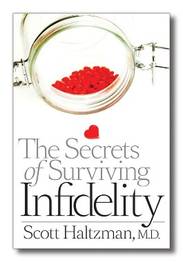
The book is the fourth in his "secrets series." The three previous books are "The Secrets of Happily Married Men" (New York: Jossey-Bass, 2007); "The Secrets of Happily Married Women" (New York: Jossey-Bass, 2008); and "The Secrets of Happy Families" (New York: Jossey-Bass, 2009).
Like his other books, "Surviving Infidelity" has a writing style that is easy on the reader and mixes just the right amounts of scientific research, clinical examples from his practice, relevant humor, cultural commentary (Tiger Woods and the reality TV show "The Bachelor" are discussed), and direct quotes from couples who have posted to his website.
While entertaining, he is always respectful as he seeks to unravel this complex subject without oversimplifying the challenges and moralizing about the sins of offenders. Unusual in the self-help literature on infidelity, Dr. Haltzman is writing as much for those who have been unfaithful as for those who have been injured by the infidelity.
The book begins with chapters asking, "Why people cheat?" Answer: for the same reasons people fall in love – wishes to feel special, important, and attractive; for connection; and for sexual gratification.
Throughout the book, Dr. Haltzman also emphasizes the pernicious impact of unrealistic expectations about marriage, such as the notion that the institution should meet all of our patients’ many, often semiconscious desires.
After discussing the cooling of romantic passion in marriage and some underlying biological forces that might encourage sexual infidelity, Dr. Haltzman notes that while our animal biology might press for multiple partners, this is an insufficient explanation for affairs. "It’s not okay to steal food because of the biological sensation of appetite, nor is shooting a neighbor’s barking dog permitted because of a biological need for sleep," writes Dr. Haltzman, who served in the department of psychiatry at Brown University, Providence, R.I., for 20 years and now practices psychiatry at the David Lawrence Center, Naples, Fla.
After stating that "Recovering from infidelity, stripped to its essentials, is all about rebuilding trust," Dr. Haltzman then lays out a useful sequential map for recovery, moving from full-disclosure, to transparency, to forgiveness and reconciliation (should that seem sensible), and to work to understand the affair and improve the marriage. He has particularly useful/practical suggestions concerning what makes for effective apologies and for improved sexual relations when the affair is still on the couple’s mind.
In answering the question, "Is there always a problem in marriage where there was an affair?" Dr. Haltzman answers, yes – unlike the late researcher Shirley P. Glass, Ph.D., who famously stressed that couples therapists overemphasized this and underemphasized issues of disinhibition. These latter issues come to fore when men and women work closely together on business trips. Dr. Haltzman quickly amends this cleverly and writes: "Not only is there a marital problem in every marriage in which infidelity happens, there is a marital problem in every marriage in which infidelity does not happen. This is to say every marriage has problems."
Readers who wish to learn more about these universal problems will gain useful insights from this book, which concludes with some highlights from Dr. Haltzman’s other books on how to improve marital happiness.
Dr. Nielsen is a psychiatrist and psychoanalyst specializing in couples therapy, the subject of his upcoming book, "Couple Therapy Integrated: Systems Theory, Psychodynamics, and Psychoeducation" (New York: Routledge, 2013). He is with the department of psychiatry at Northwestern University, Chicago, and is on the faculty of the Chicago Institute for Psychoanalysis. Dr. Nielsen also is on the faculty of the Family Institute at Northwestern University, Evanston, Ill., where his undergraduate course, Marriage 101: Building Loving and Lasting Relationships, is a perennial favorite.