
Value-Based Purchasing Raises the Stakes


Setting upfront expectations about the hospital stay during the admissions process also can help. Richardson says patients naturally compare a hospital’s noise level to that of their own homes unless a doctor or other staff member provides the proper context. Letting patients know what to expect and reminding them that they’ll likely have to be awakened a few times during the night can make a big difference in whether they rate the hospital as being sufficiently quiet, she says.
Competition Breeds Cooperation
Hospitals likely will be able to differentiate themselves the most through the national competition’s patient perception of care scores, VHA Inc.’s Dr. Haywood says, largely because the contenders have had less time to prepare for them than for the clinical process-of-care measures. Among the eight HCAHPS measures, Dr. Haywood says, focusing on doctor communication, nurse communication, hospital staff responsiveness, and a quiet room might provide the biggest return on investment.
“If physicians don’t communicate effectively with the nurses, then the nurse communication score goes down because the patients assume that the nurses know the care plan,” he says. “A typical question that we see all the time is that the nurse will ask the patient, ‘Did the doctor come and see you today?’ And if the patient says yes, then the nurse will ask, ‘Well, what did the doctor say?’ because the nurse doesn’t know.”
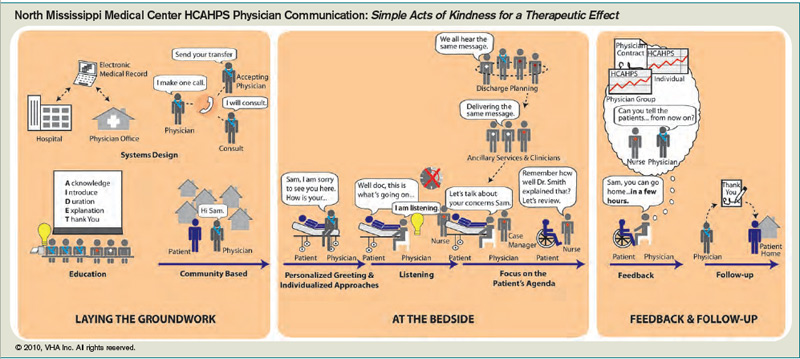
With VBP in mind, Dr. Haywood’s health system repurposed part of its catalogue of Web-based blueprints designed to help hospitals improve their clinical practices (see Figure 2, below). The cooperative is now making its collection of more than 100 blueprints available to its members to help them prop up sagging core measure scores. All depict best-practice solutions in an easy-to-remember visual format, based on weeklong site visits to exemplary hospitals from a clinical team that includes a cultural anthropologist and graphic artist.
Arkansas’ Magnolia already exceeds the national average for every HCAHPS score except the overall rating, a score that will likely increase because most patient evaluations were conducted before a new facility replaced the previous, aging hospital in February 2010. Rogers says Magnolia’s weekend hospitalist has helped with continuity of care—an important factor for maintaining high satisfaction in a small, rural community where doctors tend to see the same elderly patients on a frequent basis. The patients know the hospitalist by name, she says, “so they almost have as much of a relationship to him as they do with their primary-care physician.”
Rogers says the weekend hospitalist also has helped improve some of the hospital’s lagging pneumonia-related scores by educating and communicating with other members of the medical staff about their respective responsibilities. Because he has gained the trust of his peers, Rogers says, he’s helped the hospital get more buy-in from them as well.
Embracing the role of VBP champion, Dr. Torcson says, could help further define the worth of hospitalists to their employers. And with a trend toward more individual physician accountability, rising to the occasion now could help hospitalists stay on top of their own game. TH
Bryn Nelson is a freelance medical writer in Seattle.
Scorecards and Price Tags: VBP’s Bottom Line
Hospitalists likely won’t be involved in calculating exactly how much hospitals stand to lose or gain with value-based purchasing. Nonetheless, knowing a little about how the scoring system works can help put your facility’s potential scores and their impact on the bottom line into perspective. Consider the example of patients’ perception of doctor communication, one of eight measures in the HCAHPS surveys.
In this case, Hospital A initially struggles with its baseline score, ranking only in the 42nd percentile among all hospitals. In order to receive any achievement points, the hospital would have to climb to at least the 50th percentile.
Fortunately, Hospital A improves to the 64th percentile during the performance period (which begins July 1). Based on the CMS scoring system, it would receive 3 achievement points or 4 improvement points. The latter score is higher, so the hospital gains 4 out of 10 possible points, giving it a final score of 40%.
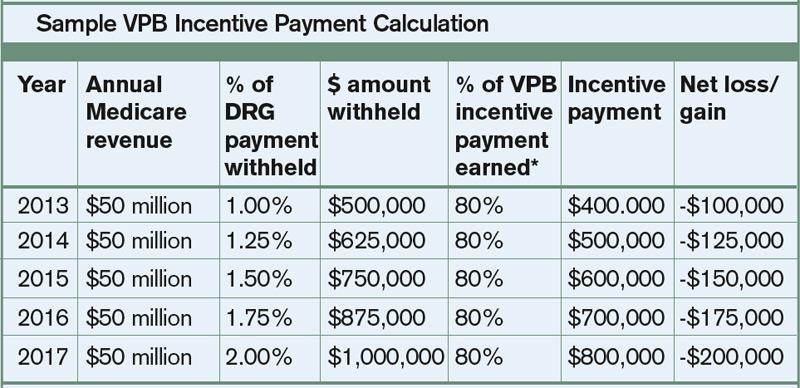
Let’s say this same hospital is eligible for 23 of the 25 measures, and gets a total performance average of 57% (or 5.7 out of 10 possible points on all measures). Based on the current exchange function, that hospital would get back about 80% of its withheld DRG reimbursements from CMS. What does that mean in terms of money? The table below offers a sample calculation, revealing that Hospital A could lose about $100,000 next year, and up to $200,000 in 2017.

