ADVERTISEMENT

Time-Based Physician Services Require Proper Documentation

The Hospitalist. 2015 February;2015(02):

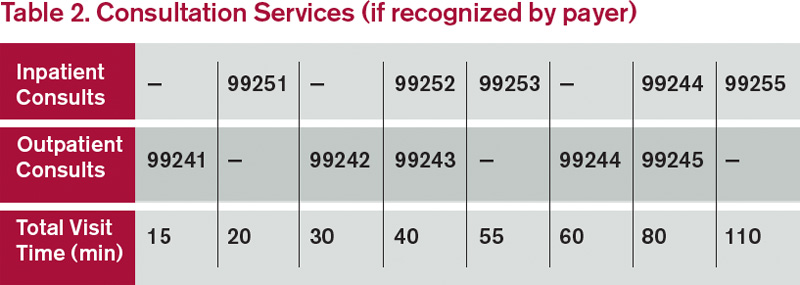
(click for larger image)Table 2. Consultation Services (if recognized by payer)

Family Discussions

Family discussions are a typical event involved in taking care of patients and are appropriate to count as C/CC time. Special circumstances are considered when discussions must take place without the patient present. This type of counseling time is recognized but only counts towards C/CC time if the following criteria are met and documented:

  • The patient is unable or clinically incompetent to participate in discussions;
  • The time is spent on the unit/floor with the family members or surrogate decision makers obtaining a medical history, reviewing the patient’s condition or prognosis, or discussing treatment or limitation(s) of treatment; and
  • The conversation bears directly on the management of the patient.3

Time cannot be counted if the discussion takes place in an area outside of the patient’s unit/floor (e.g. in the physician’s office) or if the time is spent counseling the family members through their grieving process.

It is fairly common for the family discussion to take place later in the day, after the physician has completed morning rounds. If the earlier encounter involved C/CC, the physician would report the cumulative time spent for that service date. If the earlier encounter was a typical patient assessment incorporating the components of an evaluation (i.e., history update and physical) and management (i.e., care plan review/revision) service, the meeting time may qualify for prolonged care services.
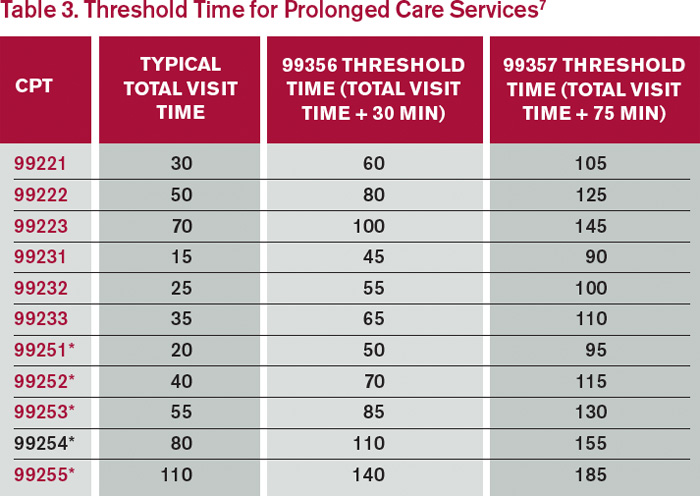
(click for larger image)Table 3. Threshold Time for Prolonged Care Services7

Service Provider

Be sure to count only the physician’s time spent in C/CC. Counseling time by the nursing staff, the social worker, or the resident cannot contribute toward the physician’s total visit time. When more than one physician is involved in services throughout the day, the physicians should select a level of service representative of the combined visits and submit the appropriate code for that level under one physician’s name.4

Consider the following example: The hospitalist takes a brief history about overnight events and reviews some of the pertinent information with the patient. He/she then leaves the room to coordinate the patient’s ongoing care in anticipation that the patient will be discharged over the next few days (25 minutes). The resident is asked to continue the assessment and counsel the patient on the patient’s current disease process (20 minutes).

In the above scenario, the hospitalist is only able to report 99232, because the time spent by the resident is “nonbillable time.”


Carol Pohlig is a billing and coding expert with the University of Pennsylvania Medical Center, Philadelphia. She is also on the faculty of SHM’s inpatient coding course.

Prolonged Care Reminders

Prolonged care codes exist for both outpatient and inpatient services. Hospitalist opportunities for prolonged care mainly involve inpatient code series:

  • 99356: Prolonged service in the inpatient or observation setting, requiring unit/floor time beyond the usual service; first hour.
  • 99357: Prolonged service in the inpatient or observation setting, requiring unit/floor time beyond the usual service; each additional 30 minutes.

Both of these codes are considered “add-on” codes and cannot be reported without a primary service. In this case, the appropriate “inpatient” E/M code (e.g. 9922x, 9923x, 9925x) represents the “primary” service. Code 99356 is reported during the first hour of prolonged services, beyond the initial encounter time, and 99357 is used for each additional 30 minutes of prolonged care beyond the first prolonged care hour. Only one unit of 99356 may be reported per patient per physician group per day, whereas multiple units of 99357 may be reported in a single day.

The CPT definition of prolonged care varies from that of the Centers for Medicare and Medicaid Services (CMS). CPT recognizes the total duration spent by a physician on a given date, even if the time spent by the physician on that date is not continuous; the time involves both face-to-face time and unit/floor time.5 CMS only counts direct face-to-face time between the physician and the patient toward prolonged care billing. Time spent reviewing charts or discussion of a patient with house medical staff that does not involve direct face-to-face contact with the patient, or waiting for test results, for changes in the patient’s condition, for end of a therapy, or for use of facilities cannot be billed as prolonged services.6 This contradicts policy for C/CC services and makes prolonged care services an inefficient practice method.

Medicare also identifies “threshold” time (see Table 3).7 The total physician visit time must exceed the time requirements associated with the “primary codes by a thirty”-minute threshold (e.g. 99221 + 99356 = 30 minutes + 30 minutes = 60 minutes threshold time). The physician must document the total face-to-face time spent in separate notes throughout the day or in one cumulative note. The latter method is a more realistic option for physicians. When two providers from the same group and same specialty provide services on the same date (e.g. physician A saw the patient during morning rounds, and physician B spoke with the patient/family in the afternoon), only one physician can report the cumulative service.4 As always, query payers for coverage, because some non-Medicare insurers do not recognize these codes.—CP