
ADVERTISEMENT

Time-based billing allows hospitalists to avoid

The Hospitalist. 2012 March;2012(03):

Prolonged Care

Prolonged care codes exist for both outpatient and inpatient services. A hospitalists’ focus involves the inpatient code series:

99356: Prolonged service in the inpatient or observation setting, requiring unit/floor time beyond the usual service, first hour; and

99357: Prolonged service in the inpatient or observation setting, requiring unit/floor time beyond the usual service, each additional 30 minutes.
click for large version
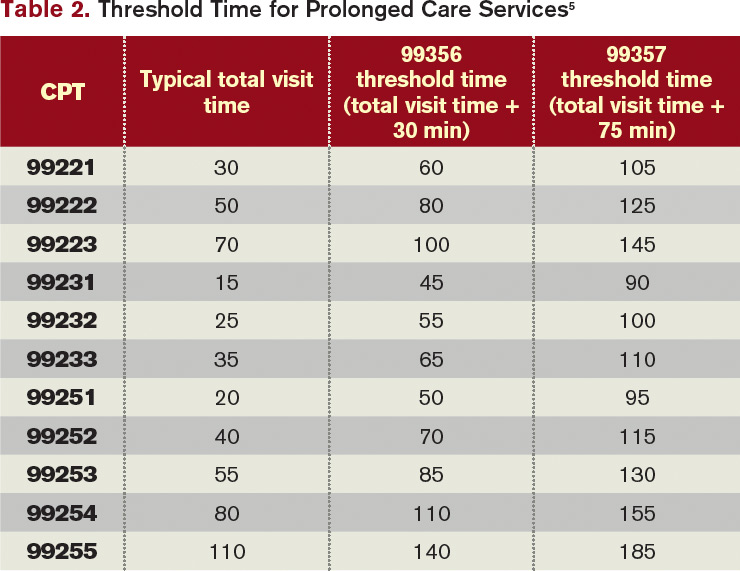
Table 2. Threshold Time for Prolonged Care Services5

Code 99356 is reported during the first hour of prolonged services, after the initial 30 minutes is reached; code 99357 is reported for each additional 30 minutes of prolonged care beyond the first hour, after the first 15 minutes of each additional segment. Both are “add on” codes and cannot be reported alone on a claim form; a “primary” code must be reported. Similarly, 99357 cannot be reported without 99356, and 99356 must be reported with one of the following inpatient service (primary) codes: 99218-99220, 99221-99223, 99231-99233, 99251-99255, 99304-99310. Only one unit of 99356 may be reported per patient per physician group per day, whereas multiple units of 99357 may be reported in a single day.

The CPT definition of prolonged care varies from that of the Centers for Medicare & Medicaid Services (CMS). Since 2009, CPT recognizes the total duration spent by a physician on a given date, even if the time spent by the physician on that date is not continuous; the time involves both face-to-face time and unit/floor time.5 CMS only attributes direct face-to-face time between the physician and the patient toward prolonged care billing. Time spent reviewing charts or discussion of a patient with house medical staff, waiting for test results, waiting for changes in the patient’s condition, waiting for end of a therapy session, or waiting for use of facilities cannot be billed as prolonged services.5 This is in direct opposition to its policy for C/CC services, and makes prolonged care services inefficient.

Medicare also identifies “threshold” time (see Table 2). The total physician visit time must exceed the time requirements associated with the “primary” codes by a 30-minute threshold (e.g. 99221+99356=30 minutes+30 minutes=60 minutes threshold time). The physician must document the total face-to-face time spent in separate notes throughout the day or, more realistically, in one cumulative note.

When two providers from the same group and same specialty perform services on the same date (e.g. physician A saw the patient during morning rounds, and physician B spoke with the patient/family in the afternoon), only one physician can report the cumulative service.6 As always, query payors for coverage, because some non-Medicare insurers do not recognize these codes.

Carol Pohlig is a billing and coding expert with the University of Pennsylvania Medical Center, Philadelphia. She is also on the faculty of SHM’s inpatient coding course.

Counseling/Coordination of Care

“Total Visit Times” are used for selecting the visit level only when the majority of the patient encounter involves counseling and/or coordination of care.6 Inpatient visit times reflect the counseling/coordination of care time spent on the hospital unit/floor by the billing provider. Time is assigned to most visit categories. Effective Jan. 1, 2012, time was assigned to observation care services, making them eligible for time-based billing:

99218: Initial observation care, per day, requiring a detailed or comprehensive history and exam; straightforward or low-complexity decision-making. Counseling and/or coordination of care with other providers or agencies are provided consistent with the nature of the problem(s) and the patient’s and/or family’s needs. Usually, the problem(s) requiring admission to “observation status” are of low severity. Physicians typically spend 30 minutes at the bedside and on the patient’s hospital floor or unit.

99219: Initial observation care, per day, requiring a comprehensive history and exam; moderate complexity decision-making. Counseling and/or coordination of care with other providers or agencies are provided consistent with the nature of the problem(s) and the patient’s and/or family’s needs. Usually, the problem(s) requiring admission to “observation status” are of moderate severity. Physicians typically spend 50 minutes at the bedside and on the patient’s hospital floor or unit.

99220: Initial observation care, per day, requiring a comprehensive history and exam; high-complexity decision-making. Counseling and/or coordination of care with other providers or agencies are provided consistent with the nature of the problem(s) and the patient’s and/or family’s needs. Usually, the problem(s) requiring admission to “observation status” are of high severity. Physicians typically spend 70 minutes at the bedside and on the patient’s hospital floor or unit.

99224: Subsequent observation care, per day, requiring two of three key components: problem-focused interval history or exam; straightforward or low-complexity decision-making. Counseling and/or coordination of care with other providers or agencies are provided consistent with the nature of the problem(s) and the patient’s and/or family’s needs. Usually, the patient is stable, recovering, or improving. Physicians typically spend 15 minutes at the bedside and on the patient’s hospital floor or unit.

99225: Subsequent observation care, per day, requiring two of three key components: expanded problem-focused interval history or exam; moderate-complexity decision-making. Counseling and/or coordination of care with other providers or agencies are provided consistent with the nature of the problem(s) and the patient’s and/or family’s needs. Usually, the patient is responding inadequately to therapy or has developed a minor complication. Physicians typically spend 25 minutes at the bedside and on the patient’s hospital floor or unit.

99226: Subsequent observation care, per day, requiring two of three key components: detailed interval history or exam; high-complexity decision-making. Counseling and/or coordination of care with other providers or agencies are provided consistent with the nature of the problem(s) and the patient’s and/or family’s needs. Usually, the patient is unstable or has developed a significant complication or a significant new problem. Physicians typically spend 35 minutes at the bedside and on the patient’s hospital floor or unit.

Source: Current Procedural Terminology 2012, Professional Edition.