Quality and Quantity of the Elbow Arthroscopy Literature: A Systematic Review and Meta-Analysis


The purpose of this article is to perform a systematic review and meta-analysis of elbow arthroscopy literature to answer the following questions: “Across the world, what demographic of patients are undergoing elbow arthroscopy, what are the most common indications for elbow arthroscopy, and how good is the evidence?”
The authors hypothesized that patients who undergo elbow arthroscopy will be chiefly age <40 years, the most common indication for elbow arthroscopy will be a release/débridement, and the evidence regarding elbow arthroscopy will be poor. Also, no significant differences will exist in elbow arthroscopy publications, subjects, outcomes, and techniques based on continent/country of publication.
A systematic review was registered with the International Prospective Register of Ongoing Systematic Reviews (PROSPERO) and performed with Preferred Reporting Items for Systematic Reviews and Meta-Analyses (PRISMA) guidelines using 3 publicly available databases. Therapeutic clinical outcome investigations reporting arthroscopic elbow outcomes with levels of evidence I-IV were eligible for inclusion. All study, subject, and surgical technique demographics were analyzed and compared between continents and countries. Statistics were calculated using 1-way analysis of variance (ANOVA) to compare between continents and Pearson’s correlation coefficients to evaluate changes over time.
In total, 112 studies were included (3093 subjects; 3168 elbows; 64% male; mean 34.9 ± 14.68 years. Mean 33.4 ± 26.02 months follow-up. Most studies were level IV evidence (94.6%) and had a low Modified Coleman Methodology Score (MCMS) (mean 28.1 ± 8.06). From 1985 through 2013, the number of publications significantly increased with time (P = .004) in all continents. The 3 most common indications for elbow arthroscopy were osteochondritis dissecans (OCD), lateral epicondylitis, and release and débridement. The number of reported cases for the 3 most common indications significantly increased over time but did not differ between regions (P > .05 in all cases). Thirty-two studies (28.6%) reported clinical outcomes, the most common of which was the Mayo Elbow Performance Score, reported in 9.8% of studies. The quantity, but not the quality, of arthroscopic elbow publications has significantly increased over time. Most patients undergo elbow arthroscopy for lateral epicondylitis, OCD, and release and débridement. Pathology and indications do not appear to differ geographically with more men undergoing elbow arthroscopy than women.
Results
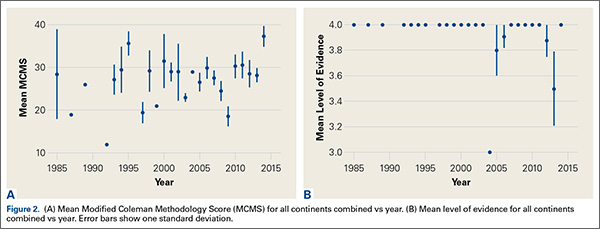
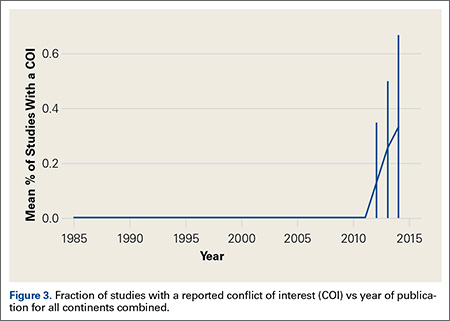
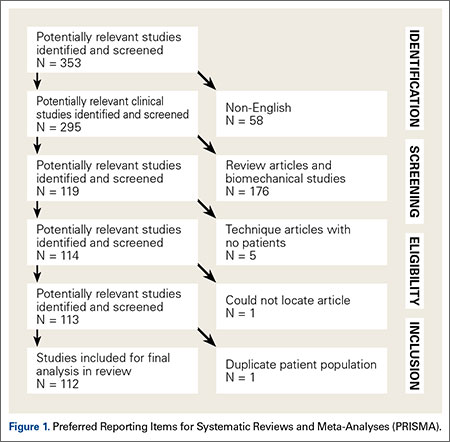
A total of 353 studies were located, and, after implementation of the exclusion criteria, 112 studies were included in the final analysis (Figure 1; 3093 subjects; 3168 elbows; 64% male; mean age, 34.9 ± 14.68 years). There was a mean of 33.4 ± 26.02 months of follow-up, and 75% of surgeries involved the dominant elbow (Table 1). Most studies were level IV evidence (94.6%), had a low MCMS (mean 28.1 ± 8.06; poor rating), and were single-center investigations (94.6%). Most studies did not report financial conflicts of interest (56.3%) (Tables 1 and 2). From 1985 through 2014, the number of publications significantly increased with time (P = .004) among all continents. The MCMS was unchanged over time (P = .247) (Figure 2A), as was the level of evidence (P = .094) (Figure 2B). Conflicts of interest significantly increased with time (P = .025) (Figure 3).
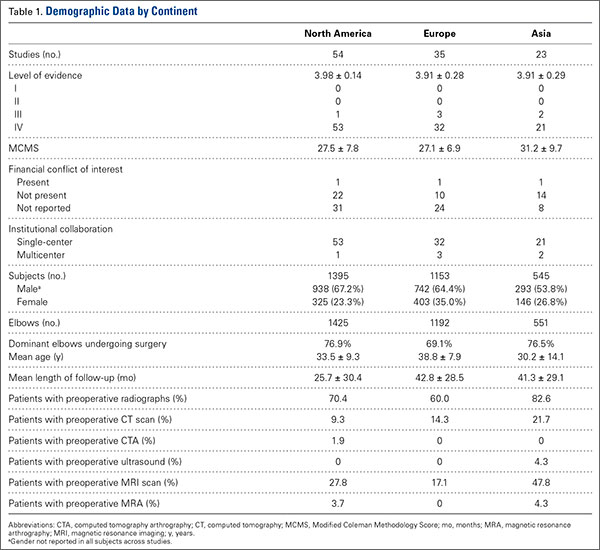
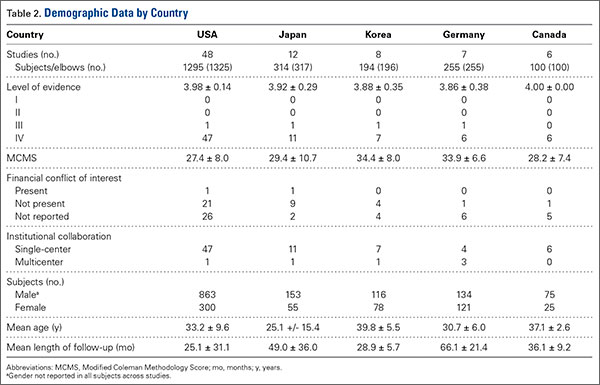
Among continents, North America published the largest number of studies (54), and had the largest number of patients (1395) and elbow surgeries (1425) (Table 1). The United States published the largest number of studies (43%). There were no significant differences between age (P = .331), length of follow-up (P = .403), MCMS (P = .123), and level of evidence (P = .288) between continents. Of the 32 studies that reported the use of preoperative MRI, studies from Asia reported significantly more MRI scans than those from other continents (P = .040); there were no other significant differences between continents in reference to preoperative imaging studies or other demographic information.