Pilot Study for an Orthopedic Surgical Training Laboratory for Basic Motor Skills


The most effective way to teach and assess a resident’s knowledge of musculoskeletal medicine, including orthopedic-specific surgical skills, remains unclear.
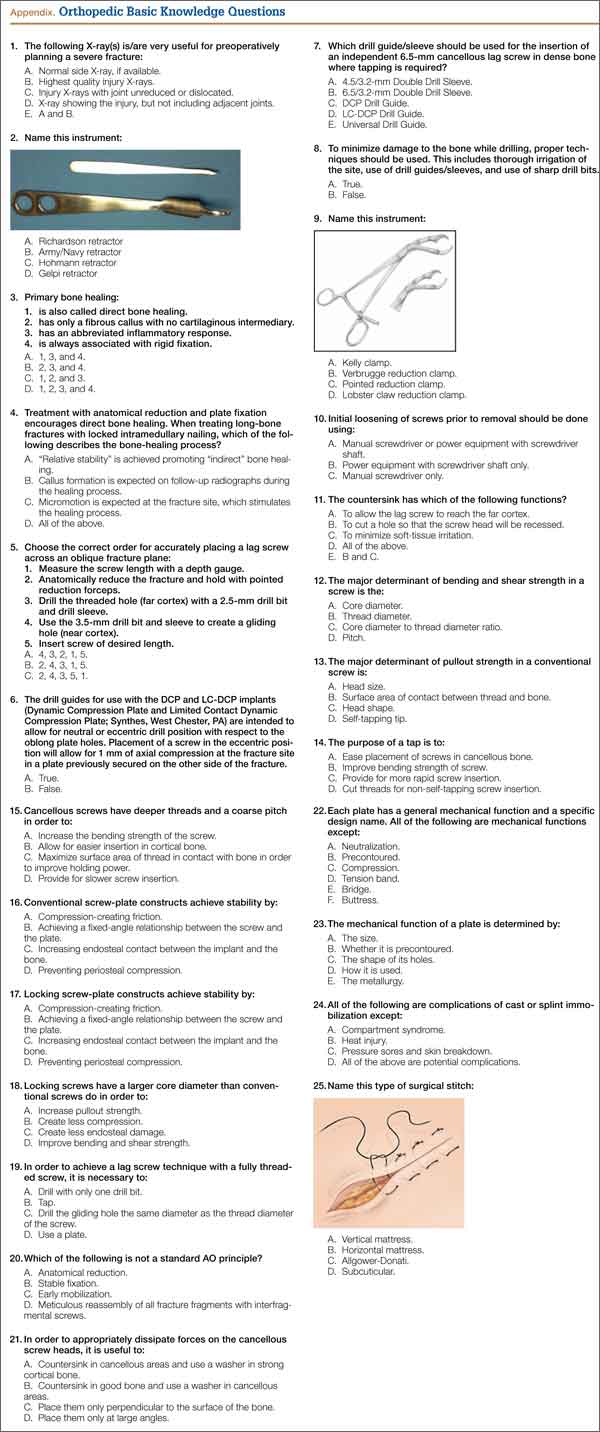
We designed a surgical skills training session to educate junior-level orthopedic residents in 4 core areas: comfort with basic power equipment, casting/splinting, suturing, and surgical instrument identification. As part of the study reported here, 11 orthopedic residents (postgraduate year 1-3) completed a skills session and were evaluated with written examinations and an ankle fracture model before and after the session. Four other junior residents were unable to attend the session because of clinical responsibilities.
For the group of 11 residents who completed the written examination, mean (SD) presession percentile was 87.3 (10.4), mean (SD) postsession percentile was 92 (8.4), median was 96, and mode was 96. There was a significant pre–post difference among all test takers, regardless of training level (P < .05). In the ankle fracture model, for the entire group, mean (SD) overall presession percentile was 68.6 (13.9), and mean (SD) overall postsession percentile was 95.2 (5.2). There was a significant pre–post difference among all test takers, regardless of training level (P = .03). An intensive laboratory has the potential to improve junior-level residents’ basic surgical skills and knowledge.
Conclusion
Orthopedic residency programs, like programs in other surgical specialties, are increasingly focused on teaching and documenting the learning of core competencies, even as work-hour restrictions and demands for clinical efficiency limit the amount of time residents spend in the operating room. We have demonstrated the potential value of an intensive laboratory in improving junior-level residents’ basic surgical skills and knowledge. We will continue to refine our methods, with a goal being to create reproducible models that could be adapted by other orthopedic residency programs and by other surgical educators.