
ADVERTISEMENT

Nice to Meet You

The Hospitalist. 2009 September;2009(09):

click for large version
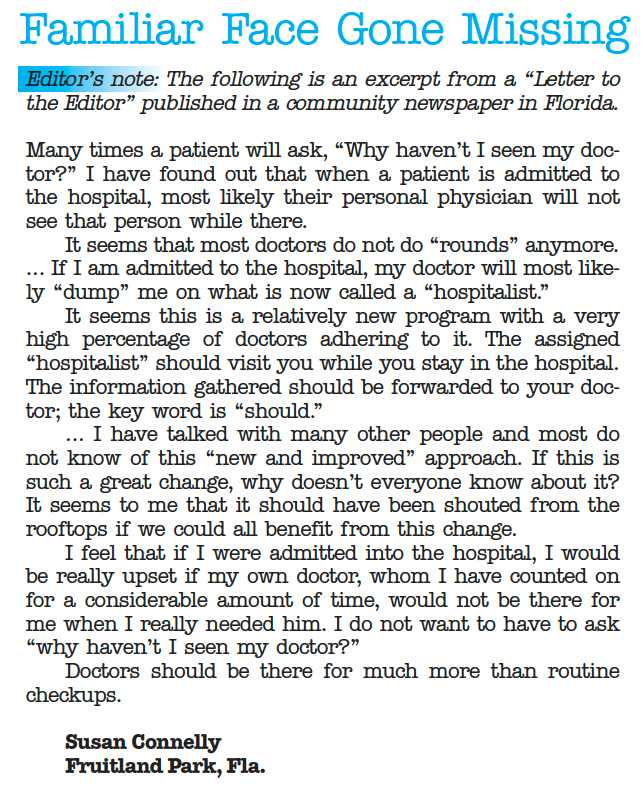
Figure 2. Letter to the Editor.

HM’s Role: Extended Education

Many HM groups have designated policies for educating patients and assuaging their fears. Because some PCPs might feel left out of the loop when hospitalists care for their patients, these strategies go beyond patient education.

One of the first steps is to involve PCPs in meaningful ways in their patients’ hospital care. When a patient is particularly angered by his PCP’s absence, invite the PCP to visit, or call the PCP more often and let the patient know you’re doing so. As proposed by Bob Wachter, MD, professor and chief of the division of hospital medicine at the University of California at San Francisco, a former SHM president, and author of the blog “Wachter’s World,” and Steven Pantilat, MD, FHM, professor of clinical medicine in the division of hospital medicine at UCSF, and a former SHM president, “the PCP can endorse the hospitalist model and the individual hospitalist, notice subtle findings that differ from the patient’s baseline, and help clarify patient preferences regarding difficult situations by drawing on their previous relationship with the patient. This visit may also benefit the PCP by providing insights into the patient’s illness, personality, or social support that he or she was unaware of previously.”2,3

Cogent Healthcare uses an outreach program to calm patient fears and connect with PCPs. The Brentwood, Tenn.-based hospitalist company distributes patient education pamphlets to the PCPs with whom they work, and distributes a flier on admission to show patients the photographs and names of their HM team (see “Make Patient Education A Priority,” p. 29).

Hospitalist training in this arena helps prepare physicians for a potentially uncomfortable work environment. “We need to stress in residency training the specific issue of helping make the patient feel comfortable when their own doctor is not seeing them in the hospital,” Dr. Centor says. “Most young hospitalists right out of their residencies have not experienced primary-care practice, and, so far, we don’t know how to get around that.”

Hospitalist groups also should consider broad initiatives to bring hospitalists together with patient representatives and other volunteers who work with patients. If volunteers are ignored in the educational outreach process, it could exacerbate patients’ negative reactions. Teach volunteers what hospitalists are, their benefit to care delivery, and their value in upholding the mission of quality HM. TH

Andrea Sattinger is a freelance writer based in North Carolina.

References

  1. Centor RM. A hospitalist inpatient system does not improve patient care outcomes. Arch Intern Med. 2008;168(12):1257-1258.
  2. Lo B. Ethical and policy implications of hospitalist systems. Dis Mon. 2002;48(4):281-290.
  3. Wachter RM, Pantilat SZ. The “continuity visit” and the hospitalist model of care. Dis Mon. 2002;48(4): 267-272.

Image Source: PETRI ARTTURI ASIKAINEN / GETTY IMAGES

Strategies to Ease Patient Concerns

Peter Barnett, MD, MPH, an associate professor of internal medicine at the University of New Mexico Health Science Center in Albuquerque, has been working as a hospitalist for about 28 years. He also teaches and coaches, as a healthcare communication consultant, throughout the U.S. and Asia. Dr. Barnett suggests the following strategies for communicating with a patient who is upset about being assigned to an unknown physician:

Step 1: Understanding. Think about how you would feel if your patient or family member became angry. Do you feel defensive? Irritable? Sorry or apologetic? Are you sympathetic or impatient?

Step 2: Evaluate the patient’s need. Consider how you or one of your own family members might feel in a similar situation.

Step 3: Make a statement. You should consider your options before speaking; here are some examples:

  • “I don’t know why you are so upset. I am going to take care of you.”
  • “A lot of people are upset when they discover their family doctor isn't going to take care of them.”
  • “I can see that this new system is really difficult for you.”

Step 4: Ask for more information. Ask “What bothers you the most about this?” Follow with: “Let me see if I understand correctly ... ” Usually those initial interventions reduce the anger but do not necessarily eliminate it, which is to be expected.

Step 5: Reassuring conversation. Use basic language to calm patients’ fears.

  • “So you’re worried that I won’t have important information that your PCP has? Well, I do have that information and can explain how it works.”
  • “You might not know me, my credentials, and don’t fully understand the system. May I introduce myself and tell you about our hospitalist system?”
  • “What really worries you is that your PCP might not know what we do here during this hospitalization. Well, I will be communicating with your primary-care physician …”
  • “You just got your diabetes under control and now we might have to change the medicines yet again. Hmm. Let’s think about this and how to minimize the changes.”

By this time, you, the patient, and their family should be listening carefully to each other, and you should be making headway to ease their concerns.

But suppose the anger is blistering and persistent, and empathy and reflective listening do not work. Then:

  • Apologize. “I am really sorry this is so upsetting for you.”
  • Use a wish. “I wish your PCP could be here to help you, too.”
  • Set limits. Do so at the end of the discussion, and only if necessary (e.g., “I wish I had a better solution for you, but I don’t”).
  • Confront the emotion. “You know, I’d be upset, too, if I were in your spot, and I really wish that I could get your PCP for you, but I’m afraid that we really need to somehow move on and take care of you.”
  • Summarize. Relax, sit down, try to understand accurately, and take the time that is necessary to put your patient at ease. Build a relationship through dialogue.

—AS