
Marriage predicts for survival in patients with stage III non–small-cell lung cancer


Background Comprehensive anal
Objective To evaluate whether marital status is an independent predictor of clinical outcomes in patients with stage III NSCLC who are treated uniformly with curative intent.
Methods The Kaplan-Meier method and Cox proportional hazards model were used to estimate the overall survival and freedom from recurrence (FFR) in 355 patients with stage III NSCLC who were treated during 2000-2013.
Results 52% of patients in the cohort were married and were more likely to self-identify as white (P < .0001), reside in zip codes with a higher household median income (P < .0001), have Eastern Cooperative Oncology Group Performance Status of 0 (P = .001), have higher pretreatment albumin (P = .009), undergo surgery (P = .001), and have insurance (P = .029). On multivariate analysis, marital status remained an independent predictor of survival and was associated with a 40% decreased risk of death (P < .0001), further stratifying outcomes beyond gender and stage grouping. FFR was comparable between the 2 groups (P = .108).
Limitations Retrospective analysis; information on individual support system beyond the marital and insurance status and zip code income was not available.
Conclusions In a cancer such as NSCLC, in which modern therapeutic approaches have yielded only modest survival improvements despite considerable treatment-related toxicity, marital status remains an independent predictor for survival. Marriage is likely a surrogate for better psychosocial support; the scale of survival improvements seen justifies investments into supportive care interventional strategies to help advance overall outcomes.
Funding/sponsorship None
Accepted for publication September 6, 2018
Correspondence
Melissa AL Vyfhuis, MD, PhD; mvyfhuis@umm.edu OR
Josephine L Feliciano, MD; jfelici4@jhmi.edu
Disclosures: The authors report no disclosures/conflicts of interest.
Citation JCSO 2018;16(5):e194-e201
©2018 Frontline Medical Communications
doi https://doi.org/10.12788/jcso.0427
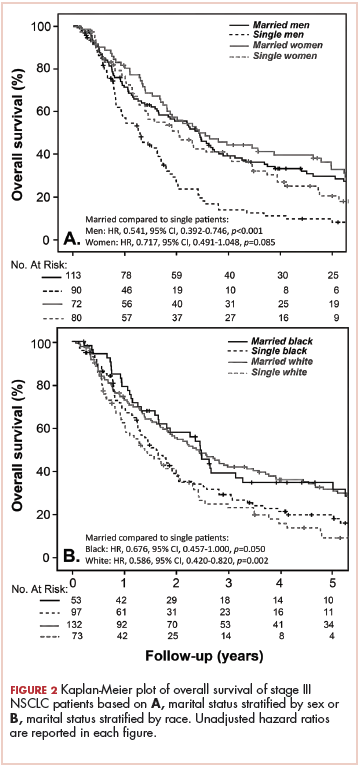
Survival as it pertains to marital status was further stratified by sex (Figure 2A) and race (Figure 2B). Married men had an improved estimated median survival of 30 months when compared with single men, whose median survival was 16 months (unadjusted HR, .541; 95% CI, 0.392-0.746; P < .0001). On the other hand, marital status had no statistically significant effect on OS when comparing married women with their single counterparts (unadjusted HR, .717; 95% CI, 0.491-1.048; P = .085; Figure 2A), with an overall median survival of approximately 28 months for the entire female cohort. Stratification by race also showed similar results, with married nonblack patients demonstrating better OS when compared with single nonblack patients (HR, .586; 95% CI, 0.420-0.820; P = .002; Figure 2B), with a median survival of 29 and 17 months, respectively. Black patients also had a similar improvement in survival when comparing the married (median survival, 30 months) and nonmarried groups (median survival, 19.6 months; unadjusted HR, .676; 95% CI, 0.457-1.000; P = .050; Figure 2B).
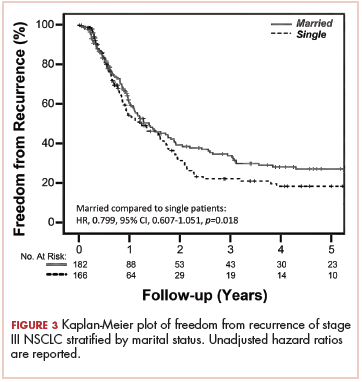
FFR did not differ between the 2 groups, with a median time to failure of 17 and 15 months for married and nonmarried patients, respectively (unadjusted HR, .799; 95% CI, 0.607-1.051; P = .108; Figure 3). Estimated 2- and 5-year FFR for married and nonmarried patients were 39.4% and 27% and 31.5% and 18.5%, respectively (Figure 3).
,
Clinical predictors of survival
On MVA, factors that were independent predictors for OS are summarized in Table 2. Risk of death was reduced by approximately 65% and 45% in patients who underwent trimodality treatment (P < .0001) or were able to undergo consolidative chemotherapy (P = .004) when compared with those who were treated definitively with bimodality treatment or did not undergo systemic doses of adjuvant chemotherapy, respectively. Having insurance (P = .048) and use of IMRT over 3D-CRT (P = .008) was associated with a reduction of mortality by about half in this cohort. Both gender (improved OS with female sex; P = .004) and marital status (improved OS with marriage; P = .006) were associated with a decreased the risk of death by 40% (Table 2). By contrast, a higher NLR resulted

Discussion
Our study continues to support the notion that marital status is an independent indicator of survival in stage III NSCLC (adjusted HR, .59; 95% CI, 0.404-0.859; P = .006). The benefit of marriage in this population seems to be better than that reported in the SEER analysis for all stages, wherein the HR for death of married patients compared with their single counterparts was .85 (95% CI, 0.83-0.87). In their analysis, the investigators hypothesized that this survival advantage could partially be explained by better access to health care and adherence to therapy, as was supported by the higher likelihood of married patients presenting with localized disease and receiving definitive treatment.3 Another population-based study using the Florida Cancer Data System identified 161,228 lung cancer patients (NSCLC and small-cell lung histology included), and on MVA, marital status remained an important prognostic indicator for OS when compared with never-married patients (HR, .86; P = .001).6 In addition to typically including patients with all stages of diseases, population-based studies often include patients who receive a heterogeneous combination of treatment modalities, possibly confounding the analysis. Furthermore, large population analyses typically do not report on patient-specific variables such as nutrition (ie, BMI and albumin) or immunologic status (ie, NLR), both of which have been shown to be independent predictors of survival in LA-NSCLC.8,9


