
HM@15 - Myriad Points of View


In Tennessee, where hospitalists were almost unheard of a decade ago, hospitalists now work in every shape and size of hospital, some with fewer than 100 beds. At one hospital that employs its own hospitalist, there are just 58 beds and an attached nursing home, Becker says.
Showing that hospitalists have been worth the cost is really as simple as looking at the length of stay, he says. “If you can knock six-tenths of a day off a stay, that’s pretty significant savings,” Becker says.
Becker notes other positives the HM model has brought to Tennessee hospitals: They make the jobs of hospital administrators easier because specialists and referring physicians are happier.
“They can spend more time doing whatever they want to do on a personal basis or in their offices,” he says. “So I think just in terms of improving relationships with the medical staffs, hospitalists have been a real plus.”
Tom Collins is a freelance writer based in Florida.
—Janet Nagamine, MD, RN, SFHM, Kaiser Permanente Medical Center, Santa Clara, Calif., SHM board member
HM@15 - Patients Benefit from Honed Relations Between Hospitalists, Staff
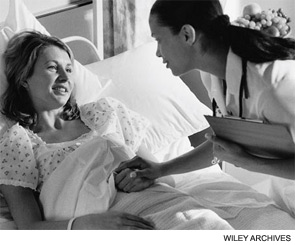
As the working relationships between hospitalists and other medical professionals have been refined through the years, so has the experience of the patients under their care, those working in the hospital say.
Glen Stream, MD, president-elect of the American Academy of Family Physicians who works with Rockwood Clinic in Spokane, Wash., says he likes to help bridge the gap between the patient and a hospitalist whom the patient probably never met before.
For example, he tells patients, “ ‘Oh, Dr. Jones is the hospitalist looking after you. He’s a really excellent physician and I agree with the things that they’re doing. I look forward to seeing you when you come home,’ ” Dr. Stream explains. “And, because I stop by, I’m going to be familiar with what was going on and what the issues were and what the follow-up should be. I think that that helps me, as their doctor, but also think that it’s a positive thing for the patient.”
Alexandra Page, MD, a member of the American Academy of Orthopaedic Surgeons’ National Health Care Systems Committee and a surgeon with Kaiser Permanente in La Jolla, Calif., says that while no hard data is available, she thinks hospitalist involvement in orthopedic procedures improves patient care.
She says her “gut feeling” is that the mortality rate would tend to fall where hospitalists are more involved. But she also says that there might be room for hospitalists to become more involved in those procedures, to become familiar with the patient at an earlier stage.
“Would it make sense for a hospitalist … since a hospitalist team would be managing them post-operatively, to consider seeing them pre-operatively? That would be the other area where I think there may be potential growth,” she says.
Dr. Nagamine says more effort is being put into familiarizing patients with hospitalists.
“I think that patients more and more understand our role,” she says. “Part of it is the communication. When the primary-care physician or whoever refers them to the hospital, it’s nice that they explain that someone else will be managing their care. When they arrive at the hospital, we explain our role. In order to gain a patient’s trust, you have to show that you know something about them, you’ve read the chart, you’ve talked to Dr. Smith.”
That transition is something that has received more attention over time, she says, with doctors increasingly providing patients business cards with photos so that they can keep track of who’s who.
“It’s something we could still work on,” Dr. Nagamine says. “But we’re very focused on patient satisfaction and communication. There’s a lot of work going on in that regard.”

