
The Future of Critical Care


Dr. Farmer agrees. “We do clinical guidelines for everyday issues, so I don’t see why we can’t do the same thing” for critical care and disaster preparedness.
Critical care is ripe for integrating clinical practice guidelines. “There are certain types of interventions that are near universal in ICUs,” says Dr. Buchman. “How we sedate patients, how we relieve pain, how we liberate someone from mechanical support … having touchstones or guidelines for these interventions will help. This is complementary to standardization of care.
“Here’s an example: A patient is admitted with a myocardial infarction. We would treat him with beta-blockers, nitrates, heparin, and aspirin. We don’t think of a standard dose of beta-blockers because the dose must be titrated to [have an] effect on the individual patient,” he continues. “How this individualization is done safely involves organizational guidelines. Systematic implementation of such guidelines will be the difference between good ICUs and great ICUs. The implementation is a continuous four-step process—learn the recommendations, deliver the care, measure the outcomes, and find ways to improve.”
Hospitalists and Critical Care
In concert with technologic advancement and improved guidelines, one major solution to the staffing shortage is hospitalists. According to Dr. Farmer, a large portion of critical care services across the country is provided by family practitioners and general internists. The demographics of the population, combined with the current system of training, ensure inadequate staffing. That shortage could be filled by hospitalists. For many hospitalists ICU care is already an important and satisfying arm of their practice. It may become necessary in the future to define skill sets to work in critical care areas. Hospitalists are well positioned to fill that need.
Looking Ahead
The area of critical care may be moving more quickly toward the future than other hospital functions because it must do so in order to continue to work at all. The success of achieving a future of quality care, patient safety, and adequate staffing rests on a different approach with providers and technology.
“We have to learn to work smarter to leverage new technology and the expertise of all other experts in other fields,” says Dr. Buchman of the future of critical care.TH
Chicago-based Jane Jerrard will write future installments of this series.
FLASHBACK:
An Ill Wind
An 1883 tornado strikes a familiar chord in today’s hurricane-ridden times
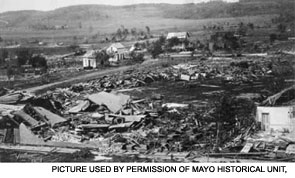
“An ill wind”—these were the opening words spoken by William Worrall, MD, at the official opening ceremony for St. Mary’s Hospital in Rochester, Minn. The hospital had been conceived following the destruction wrought on Rochester by a tornado that had left 37 dead and more than 200 injured six years earlier.
Aug. 12, 1883, was a particularly hot day, and many residents must have been hopeful of relief as they saw black clouds looming to the west late that evening. That evening Dr. William Mayo’s sons, Will and Charlie, were headed to the slaughterhouse northwest of town in the part of Rochester then known as the Lower Town to purchase a sheep’s head for eye dissections. The butchers had closed early because of the impending storm and advised the young Mayos to head back posthaste.
The cyclone descended just as they crossed a bridge, which was torn loose of its moorings, over the Zumbro River. They witnessed buildings smashed to bits, a grain elevator toppled, and railroad cars wrecked by the destructive force. They were almost killed by a heavy cornice that had ripped off the Cook House and smashed into their buggy. The Cook House was adjacent to the Cook Block that housed the offices of the Doctors Mayo. Though their buggy was destroyed, they survived and took shelter with their horse in a blacksmith’s shop.
They survived the storm, but others were not so lucky. One-third of the buildings in town were destroyed or damaged with more than half in Lower Town, a predominantly working class neighborhood. They immediately began to care for the wounded brought to the clinic offices. Their father had taken charge of relief efforts in Lower Town, the worst hit part of the city. Victims were brought to a local hotel, where they were quickly triaged and treated according to need.
The physicians in town shared a common goal though they were not always united in their methods. The routine use of an emetic for all trauma patients was advocated by one physician to the opprobrium of the elder Dr. Mayo, who quickly insisted on establishment of clear leadership. He also recruited the assistance of Sister Alfred Moes, who had offered her convent to shelter the sick and homeless and her nuns as nurses for the injured.
The anti-Catholic prejudices of the day necessitated Dr. W. Mayo asking that it be announced that Sister Alfred was offering shelter in her “house” and not in a convent. Other relief efforts such as offering food and provisions to the needy were established in available rooms across town. Recovery of bodies, funeral services, and burials were quickly conducted. Rebuilding efforts were speedily begun with fundraising activities bringing in enough funds to feed and clothe hundreds, rebuild more than 100 houses, and provide money for furniture.
The tornado had highlighted the need for a hospital in Rochester and Sister Alfred ultimately requested that Dr. W. Mayo assist in this venture. The Sisters of Saint Francis raised money and built Saint Mary’s Hospital—the first in Rochester.
The destruction and chaos caused by Hurricane Katrina has brought much pain to our nation. In the early aftermath there appeared to be a dearth of leadership, and questions arose regarding an apparent lack of preparedness and poor response to the carnage caused by the storm. Undoubtedly there will be many investigations into what went wrong. History may help answer these questions, but should also provide reassurance that good can come out of the debris of an ill wind.
—Jamie Newman, MD, FACP, and Adeboye B. Ogunseitan, MD

