Fingertip Amputation Treatment: A Survey Study


Distal fingertip amputations are common injuries in work- and non-work-related accidents. There is a paucity of evidence to support use of any one treatment.
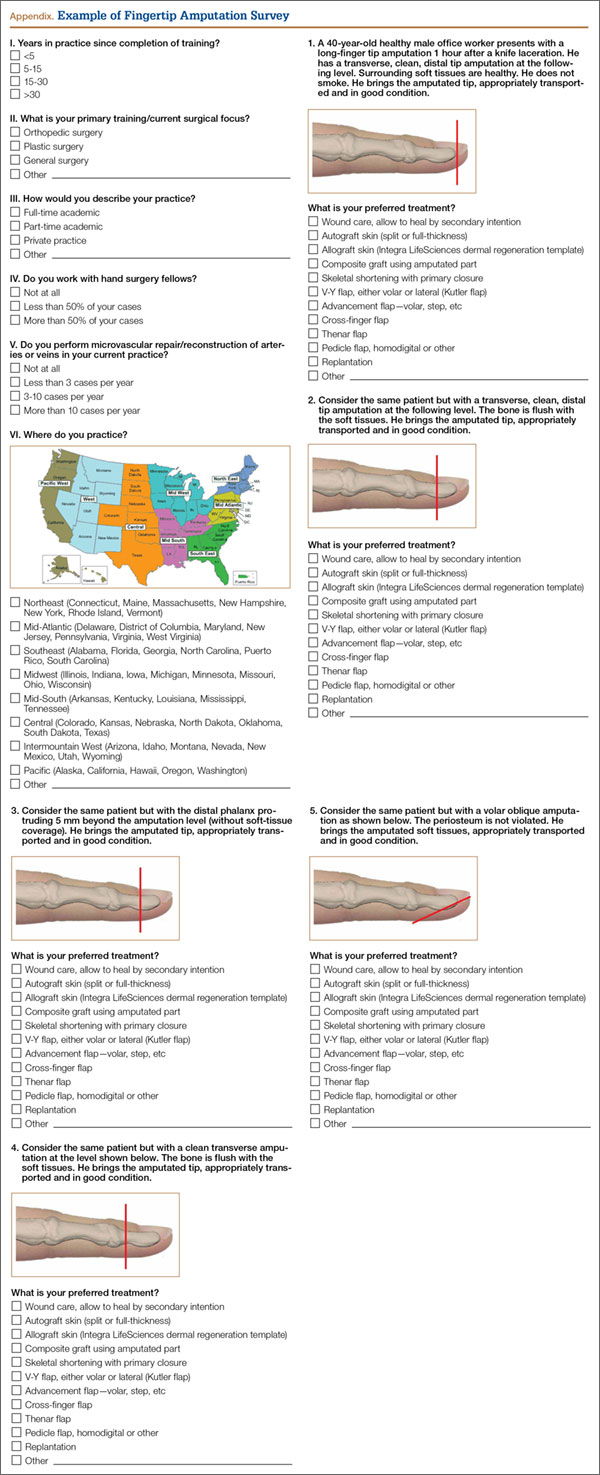
We conducted a study to better understand how surgeon and patient factors influence the treatment preferences for distal fingertip amputations among a cross section of US and international hand surgeons. We sent a 16-question survey to the American Association for Hand Surgery and reciprocal international hand societies and analyzed the response data using a logistic regression model. We hypothesized that hand surgeons’ treatment preferences would be varied and influenced by surgeon and patient demographics.
One hundred ninety-eight hand surgeons (62% US, 38% international) responded to the survey. For each clinical scenario (Allen levels 2, 3, and 4 and volar oblique amputations), there were wide variations in treatment preferences. Wound care was less likely performed by surgeons with more than 30 years of experience or plastic surgery backgrounds. Replantation was less likely performed by US surgeons and private practice surgeons. Pedicle and homodigital flaps were more commonly performed internationally. Surgeons in practice for less than 5 years were more likely to perform skeletal shortening.
For all levels and orientations of fingertip amputation queried, there is a wide range of treatment preferences. Our survey results highlight the need for a prospective randomized trial to elucidate the most effective treatments for fingertip amputations.
Several weaknesses of this study must be highlighted. First, our response rate was smaller than desired. Although this work incorporated a large number of surgeon responses, nearly 200, the response rate was only 17%. In addition, although number of responses was likely adequate to show the diversity of opinion, the preferences and trends reported might not be representative of all hand surgeons. We could not perform a nonresponder analysis because of a lack of specific demographic data for the AAHS and international hand society members. However, AAHS has an approximate 50/50 mix of plastic and orthopedic surgeons, similar to our responder demographic, suggesting our smaller subset of responses might be representative of the whole. According to AAHS, a majority of its members are “academic” hand surgeons, so our results might not adequately reflect the preferences of community hand surgeons and ultimately might overstate the frequency of more complex treatments. Last, our international response was limited to a few countries. A larger, more broadly distributed response would provide a better understanding of regional preferences, which could shed light on the importance of cultural differences.
Variations in patient insurance status were not queried in this survey but might also affect treatment decisions. More involved, costly, and highly reimbursing procedures might be deemed reasonable options for a small perceived clinical benefit for insured patients.
When multiple digits or the thumb is injured, or there are other concomitant injuries, surgeons may alter their choice of intervention. In mangled extremities, preservation of salvageable functional units takes precedence over aesthetics and likely affects choice of treatment for the amputated fingertips. Similarly, multiple fingertip amputations, even if all at the same level, may be differently regarded than a solitary injury.
Conclusion
For distal fingertip amputations, there is little evidence supporting one approach over another. Without level I comparative data guiding treatment, anecdotal evidence and surgeon personal preferences likely contribute to the large variation noted in this survey. Our study results showed the disparity of fingertip treatment preferences among a cross section of US and international hand surgeons. More important, results underscored the need for a well-designed comparative study to determine the most effective treatments for distal fingertip amputations.