
ADVERTISEMENT

The Cost of Regulation

The Hospitalist. 2010 June;2010(06):

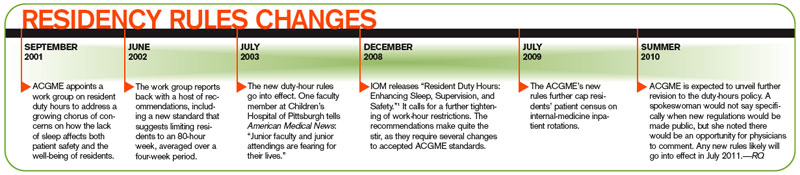
Jacob declined further comment, but various hospitalists and academics say they wouldn’t be surprised if new rules reflect 2008 Institute of Medicine (IOM) recommendations.1 The IOM report called for a maximum resident shift length of 30 hours, with admission of patients for up to 16 hours, plus a five-hour uninterrupted sleep period between 10 p.m. and 8 a.m. It also suggested the remaining workweek hours be used for transitional and educational activities.

However those IOM recommendations are incorporated, one thing is clear: Any adoption of those standards will have a financial impact. In fact, a study published last year reported that annual labor costs from implementing the IOM standards was estimated to be $1.6 billion in 2006 dollars (see “The Cost of Progress,” p. 25).2

“Any replacement of a resident costs more than a resident, whether it’s an NP, a PA (physician assistant), an MD, or a DO,” says Kevin O’Leary, MD, MS, associate program director of the IM residency program at Northwestern University’s Feinberg School of Medicine in Chicago. “Everybody costs more.”
Dr. Wallach
click for large version

The Fate of Teachers

Some of the largest academic centers, including the Feinberg School, the University of Michigan, and the teaching service at St. Luke’s-Roosevelt Hospital in New York City, reduced patient caseloads ahead of the 2009 round of residency rule changes. Hospitalists and educators at those institutions say the proactive approach helped them adjust to the newest rules, which by some estimates reduce resident productivity by 20%.

But the changes shift the workload to academic hospitalists, many of whom forego higher-paying positions to pursue teaching and research. According to the latest SHM survey data, academic hospitalists make about $50,000 less per year than the average community hospitalist. But as clinical work intrudes further, as residents are unable to assume the patient care they once did, educators are put into positions of having to balance the educational portion of their job with patient care, says John Del Valle, MD, professor and residency program director in the department of internal medicine at the University of Michigan Health System in Ann Arbor.

“This is where difficult decisions have to be made,” Dr. Del Valle says. “This is not the blend of activities that traditional academics signed up for.”

The Cost of Progress

The Institute of Medicine (IOM) was tasked by Congress in 2007 with recommending ways to balance the amount of sleep medical residents need against their need to be well-trained enough to make it on their own in medical practice.

The resulting Dec. 2, 2008, report heard ’round the medical world accomplished that goal; it recommended five days off per month, one 48-hour period off per month, and a maximum shift length of 30 hours, with admission of patients for up to 16 hours.1 Perhaps most striking was the IOM’s recommendation for a continuous and protected five-hour period of sleep between 10 p.m. and 8 a.m.

What the IOM report skips over is the cost of its recommendations. That’s where Teryl Nuckols, MD, MSHS, steps in. Last year, Dr. Nuckols and colleagues at the University of California at Los Angeles and RAND Corporation, published “Cost Implications of Reduced Work Hours and Workloads for Resident Physicians.”1 The review found that implementing the report’s four main conclusions—improved adherence to Accreditation Council for Graduate Medical Education (ACGME) limits, naps during extended shifts, a 16-hour limit for shifts without naps, and reduced workloads—would cost the country’s teaching hospitals about $1.6 billion per year.

Using sensitivity analyses, that figure ranges from $1.1 billion to $2.5 billion, with the annual cost to an individual academic hospital estimated at $3.2 million. All figures are in U.S. dollars as of 2006.

Although the IOM report only suggests changes, many hospitalists expect at least some version of the recommendations to become ACGME policy. “It may force us to move toward complete day- and night-shift models, which we have a lot of services for seniors,” says John Del Valle, MD, professor and residency program director for the IM department at the University of Michigan Health System. “But we all of a sudden have to create capacity for that dual-shift model.”

While cost considerations can’t be brushed aside, some residency program directors have embraced the intent of the IOM recommendations to provide more rest for residents, be they in their first or fourth year.

“Maybe physicians shouldn’t be working tired,” says Ethan Fried, MD, MS, FACP, president-elect of the Association of Program Directors in Internal Medicine (APDIM). “Maybe physicians need to be in networks that will be available for heavy-duty patient care, even when one member is tired. It may not be the end of modern civilization as we know it if we decide that working when you’re tired is not a value we need physicians to have anymore.”—RQ