Clinical Outcomes of Anatomical Total Shoulder Arthroplasty in a Young, Active Population


Glenohumeral arthritis in young, active patients poses many treatment challenges, and significant concerns about component loosening and failure limit the available surgical options.
We conducted a study of the clinical outcomes of total shoulder arthroplasty (TSA) for glenohumeral arthritis in a young, high-demand population. We searched the Military Health System Management Analysis and Reporting Tool database to retrospectively review the cases of all US military service members who had undergone anatomical TSA (Current Procedural Terminology code 23472) between 2007 and 2014. Demographic information, occupational parameters, and clinical outcomes were extracted from electronic medical records.
Twenty-four service members (26 shoulders) met the inclusion criteria. The cohort was predominantly male (n = 25). Mean age was 45.8 years (range, 35-54 years). The most common etiology of glenohumeral arthritis was post-instability arthropathy (50.0%). At mean follow-up of 41 months, 9 patients had a total of 12 complications (46.2%), including 6 component failures caused by neurologic injury (2 cases), adhesive capsulitis (2), and venous thrombosis (2). The reoperation rate for all component failures was 23.1% (6 cases, 5 patients). Ten patients (41.7%) remained on active duty at 2 years, and 5 (20.8%) were subsequently deployed. Ultimately, 9 patients (37.5%) underwent medical discharge for persistent shoulder disability.
TSA in young, active patients provides reliable improvements in range of motion and pain. However, roughly one-third of patients in this study were unable to continue high-demand activities by 2 years after surgery. The short-term complication profile (46.2%) and reoperation rate for component failure (23.1%) should be emphasized during preoperative counseling.
Complications
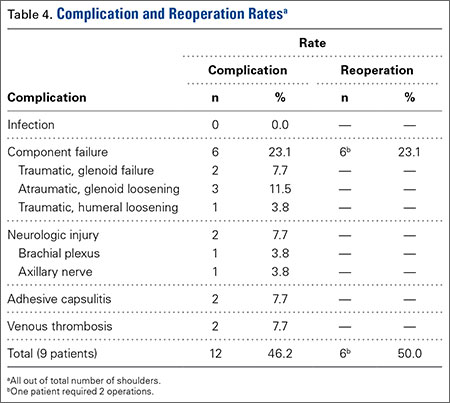
Nine patients had a total of 12 postoperative complications (46.2%): 6 component failures (23.1%), 2 neurologic injuries (7.7%; 1 permanent axillary nerve injury, 1 transient brachial plexus neuritis), 2 cases of adhesive capsulitis (7.7%), and 2 episodes of venous thrombosis (7.7%; 1 superficial, 1 deep) (Table 4). There were no documented infections. Six reoperations (23.1%) were performed for the 6 component failures (2 traumatic dislocations of prosthesis resulting in acute glenoid component failure, 3 cases of atraumatic glenoid loosening, 1 case of humeral stem loosening after periprosthetic fracture). Atraumatic glenoid component loosening occurred a mean (SD) of 40.6 (14.2) months after surgery (range, 20.8-54.2 months).
Surgical Failures
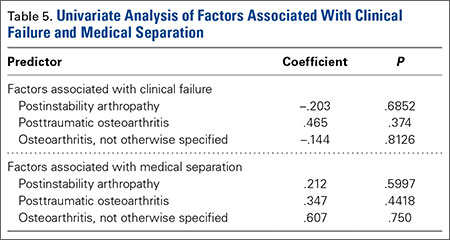
Eight service members underwent MEB. Six patients experienced component failure. Factors contributing to both clinical failure and separation from active duty by means of MEB were evaluated with univariate analysis (Table 5). No statistically significant risk factors, including surgical revision and presence of perioperative complications, were identified.
Discussion
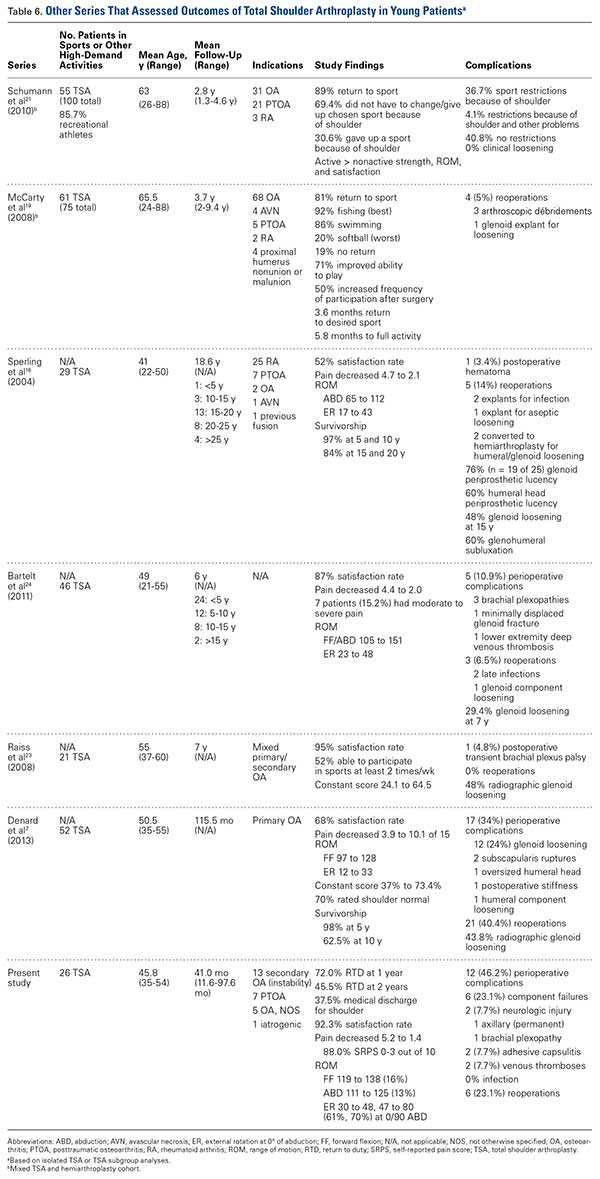
We confirmed that our cohort of young service members (mean age, 45.8 years), who had undergone TSA for glenohumeral arthritis, had a relatively higher rate of component failure (23.1%) and a higher reoperation rate (23.1%) with low rates of return to military duty at short-term to midterm follow-up. Our results parallel those of a limited series with a younger cohort (Table 6).7,16,19,21,23,24 The high demand and increased life expectancy of the younger patients with glenohumeral arthritis potentiates the risk of complications, component loosening, and ultimate failure.29 To our knowledge, the present article is the first to report clinical and functional outcomes and perioperative risk profiles in a homogenously young, active military cohort after TSA.