
Clinical Outcomes of Anatomical Total Shoulder Arthroplasty in a Young, Active Population


Glenohumeral arthritis in young, active patients poses many treatment challenges, and significant concerns about component loosening and failure limit the available surgical options.
We conducted a study of the clinical outcomes of total shoulder arthroplasty (TSA) for glenohumeral arthritis in a young, high-demand population. We searched the Military Health System Management Analysis and Reporting Tool database to retrospectively review the cases of all US military service members who had undergone anatomical TSA (Current Procedural Terminology code 23472) between 2007 and 2014. Demographic information, occupational parameters, and clinical outcomes were extracted from electronic medical records.
Twenty-four service members (26 shoulders) met the inclusion criteria. The cohort was predominantly male (n = 25). Mean age was 45.8 years (range, 35-54 years). The most common etiology of glenohumeral arthritis was post-instability arthropathy (50.0%). At mean follow-up of 41 months, 9 patients had a total of 12 complications (46.2%), including 6 component failures caused by neurologic injury (2 cases), adhesive capsulitis (2), and venous thrombosis (2). The reoperation rate for all component failures was 23.1% (6 cases, 5 patients). Ten patients (41.7%) remained on active duty at 2 years, and 5 (20.8%) were subsequently deployed. Ultimately, 9 patients (37.5%) underwent medical discharge for persistent shoulder disability.
TSA in young, active patients provides reliable improvements in range of motion and pain. However, roughly one-third of patients in this study were unable to continue high-demand activities by 2 years after surgery. The short-term complication profile (46.2%) and reoperation rate for component failure (23.1%) should be emphasized during preoperative counseling.
Statistical Analysis
Continuous variables were compared using statistical means with 95% confidence intervals (CIs) and/or SDs. Categorical data were reported as frequencies or percentages. Univariate analysis was performed to assess the correlation between possible risk factors and the primary outcome measures. P < .05 was considered statistically significant.
Results
Demographics
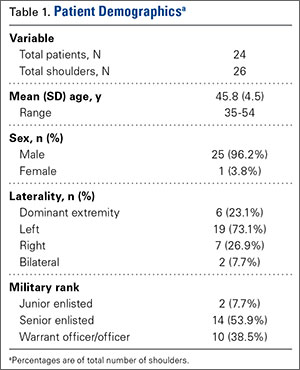
We identified 24 service members (26 shoulders) who had undergone anatomical TSA during the study period (Table 1). Mean (SD) age was 45.8 (4.5) years (range, 35-54 years), and the cohort was predominately male (25/26 shoulders; 96.2%). Most cohort members were of senior enlisted rank (14, 58.3%), and the US Army was the predominant branch of military service (13, 54.2%). The right side was the operative extremity in 7 cases (26.9%), and the dominant shoulder was involved in 6 cases (23.1%). Two patients (8.3%) underwent staged bilateral TSA. Most patients (76.9%) underwent TSA on the nondominant extremity.
Surgical Variables
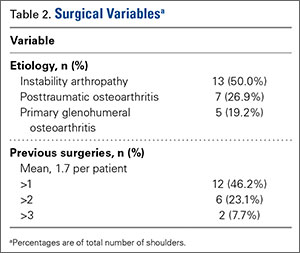
TSA was indicated for post-instability arthropathy in 13 cases (50.0%), posttraumatic osteoarthritis in 7 cases (26.9%), and unspecified glenohumeral arthritis, which includes primary glenohumeral osteoarthritis, in 5 cases (19.2%) (Table 2). One case was attributed to iatrogenically induced chondrolysis secondary to intra-articular lidocaine pump. Twelve patients (46.2%) had at least 1 previous surgery. Of the shoulders with instability, 10 (76.9%) had undergone a total of 14 surgical stabilization procedures—10 anterior labral repairs, 2 posterior labral repairs, and 2 capsular plications. The other shoulders had undergone a total of 18 procedures, which included 4 rotator cuff repairs and 3 cartilage restoration procedures.
Clinical Outcomes
Mean (SD) follow-up was 41.0 (21.3) months (range, 11.6-97.6 months). All but 1 shoulder (96.2%) had follow-up of 12 months or more (the only patient with shorter follow-up was because of MEB), and 76.9% of patients had follow-up of 24 months or more (4 of the 6 patients with follow-up under 24 months were medically separated) (Table 3). In all cases, mean ROM improved with respect to flexion, abduction, and external rotation. At final follow-up, mean (SD) ROM was 138° (36°) forward flexion (range, 60°-180°), 125° (39°) abduction (range, 45°-180°), 48° (19°) external rotation at 0° abduction (range, 20°-90°), and 80° (9.4°) external rotation at 90° abduction (range, 70°-90°). Preoperative flexion, abduction, and external rotation at 0° and 90° abduction were all improved at final follow-up. The most improvement in ROM occurred within 6 months after surgery.
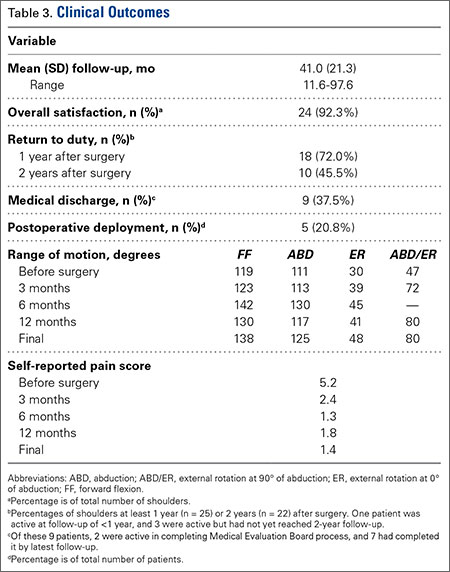
Overall patient satisfaction with surgery was 92.3% (n = 24). Ultimately, 18 (72.0%) of 25 shoulders with follow-up of 1 year or more were able to return to active duty within 1 year after surgery, though only 10 (45.5%) of 22 with follow-up of 2 years or more remained active 2 years after surgery. Furthermore, 5 patients (20.8%) were deployed after surgery, and all were still on active duty at final follow-up. By final follow-up, 9 (37.5%) of 24 service members were unable to return to military function; 7 had been medically discharged from the military for persistent shoulder disability, and 2 were in the process of being medically discharged.
In all cases, SRPS improved from before surgery (5.2 out of 10) to final follow-up (1.4). At final follow-up, 22 patients (88.0%) reported mild pain (0-3), and no one had pain above 6.


