
Detecting cancer: Pearls for the primary care physician


ABSTRACTFive-year survival rates have improved over the past 40 years for nearly all types of cancer, partially thanks to early detection and prevention. Since patients typically present to their primary care physician with initial symptoms, it is vital for primary care physicians to accurately diagnose common cancers and to recognize unusual presentations of highly curable cancers such as Hodgkin lymphoma and testicular cancers, for which the 5-year overall survival rates are greater than 85%. This paper reviews these cancers and provides clinically relevant pearls from an oncologic perspective for physicians who are the first point of contact.
KEY POINTS
- By detecting breast cancer lesions 2 years before they are discovered by clinical breast examination, mammography has been found to reduce the mortality rate from breast cancer.
- In the United States, 20% of colorectal cancer patients have distant metastases at the time of diagnosis. The most common sites are the lymph nodes, liver, lungs, and peritoneum.
- The patient should fully understand the risks and benefits of prostate-specific antigen (PSA) screening and that it is controversial because, since the advent of PSA testing, the lifetime risk of being diagnosed with prostate cancer has increased, but the lifetime risk of dying from it has remained the same.
LUNG CANCER
Lung cancer is the second most common type of cancer in men and women but has the highest mortality rate. In the United States, in 2015, an estimated 221,200 new cases of lung cancer and 158,040 deaths were expected.2 Lung cancer deaths have begun to decline in both men and women, and this is due to the decline in smoking. The impact of lung cancer screening may not be seen for another 5 to 10 years.29
A wide range of symptoms, presentations
Many patients with squamous cell carcinoma and small-cell lung carcinoma present with symptoms related to tumor involvement of the central airways,30 including cough, hemoptysis, and postobstructive pneumonia. Partial obstruction of a bronchus may cause localized wheezing, heard by the patient or by the clinician on auscultation, whereas obstruction of larger airways can cause stridor.
Patients with advanced disease present with dull, aching, persistent chest pain from mediastinal, pleural, or chest wall extension, dyspnea from lymphangitic tumor spread, tumor emboli, pneumothorax, pleural effusion, or pericardial effusion with tamponade. Less commonly, patients may present with unilateral paralysis of the diaphragm from phrenic nerve damage or with hoarseness from recurrent laryngeal nerve compression.31
Bronchorrhea—production of large volumes of thin, mucoid secretions resulting in cough—may be a feature of bronchoalveolar cell carcinoma, a rare subtype of non-small-cell lung carcinoma.
Patients uncommonly present with superior vena cava syndrome, an oncologic emergency that most often causes facial and arm swelling, dyspnea, cough, and headache.
Non-small-cell lung carcinoma arising in the superior sulcus may in rare cases cause Pancoast syndrome (manifested by shoulder pain and atrophy of the hand muscles from brachial plexus involvement), Horner syndrome (manifested by ptosis, miosis, and anhidrosis), or rib destruction.
If metastasis occurs, lung cancer commonly metastasizes to the liver and adrenal glands. At the time of diagnosis, 20% to 30% of patients with small-cell lung carcinoma have symptoms of central nervous system metastasis.
The screening controversy
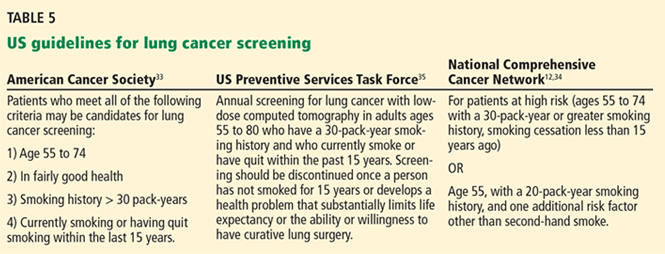
Lung cancer screening is controversial because previous large studies have failed to show a clinical benefit (ie, improved survival rates) of CT screening in smokers. However, based on the results of a later large randomized trial,32 the ACS33 now recommends that patients ages 55 to 74 who are in fairly good health, have at least a 30-pack-year smoking history, and are currently smoking or have quit smoking within the last 15 years should discuss with their physician the benefits, limitations, and potential harms of lung cancer screening. These recommendations are similar to those of the NCCN12,34 and USPSTF35 (Table 5).12,33–35 The ACS guidelines also emphasize that screening should be done only at facilities with extensive experience with low-dose CT.
Follow-up evaluation
If imaging detects a lung nodule, its size and consistency are crucial in determining the course of action.33 If an endobronchial growth or solid nodule larger than 8 mm is discovered, the primary care physician should consider ordering either a repeat low-dose CT scan after 1 month or a positron-emission tomography CT scan.34 The diagnosis should be confirmed by biopsy or by surgical removal of the nodule if localized and accessible, with sites of metastasis typically taking priority.
Pearl
- At diagnosis, 20% to 30% of patients with small-cell lung cancer have symptoms of central nervous system metastasis.
HIGHLY CURABLE CANCERS WITH UNUSUAL PRESENTATIONS
Hodgkin lymphoma
With 9,190 new cases in the United States annually and a 5-year overall survival rate over 85%, Hodgkin lymphoma is one of the least common but most curable cancers.1,2 In the United States, there are two diagnostic peaks, one around age 20 and one around age 65.36 In patients with human immunodeficiency virus infection, the rate is 15 to 30 times higher than in the general population, regardless of disease status or compliance with highly active retroviral therapy.37
Hodgkin lymphoma typically presents as a nontender painless mass with rubbery consistency. The involved lymph node is typically cervical or supraclavicular. Although not detectable on physical examination, enlarged mediastinal nodes and retroperitoneal nodes are often present. Less commonly, patients may present with enlarged axillary and inguinal nodes.38
A second common presentation is the discovery of a mediastinal mass on routine chest radiography. A large percentage of patients present with at least one systemic symptom, which may include fever, night sweats, and unintentional weight loss. Generalized pruritus occurs early in the disease course in 10% to 15% of patients and is occasionally severe enough to cause intense scratching and excoriations.
A more unusual presentation of Hodgkin lymphoma is severe pain at areas of involvement after alcohol ingestion.
Most patients present with overt disease, but the presenting symptoms and signs may be relatively nonspecific and subtle and more consistent with an infectious process.
Hodgkin disease has a variable tempo, but overt symptoms typically occur after several months rather than years. As a general rule, it starts at a single site within the lymphatic system, usually a lymph node, and then spreads to adjacent nodes via lymphatic channels before disseminating to distant nonadjacent sites and organs. With this in mind, it is unusual to have bilateral axillary involvement without disease in the lower neck, and extremely unusual to have hepatic or bone marrow infiltration without disease in the spleen.
The diagnosis is established by whole lymph node tissue biopsy. Due to the high rate of inflammation in the area, inguinal nodes should not be biopsied if other equally suspicious peripheral nodes are present elsewhere. When the diagnosis of Hodgkin lymphoma is made from biopsy of an extranodal site, such as the stomach, spleen, Waldeyer ring, central nervous system, lung, bone, or skin, lymph node biopsy is also desirable for diagnostic confirmation.
Testicular cancer
Although accounting for only about 1% of all cancers in men, testicular cancer is the most common solid tumor affecting males between ages 15 and 35.1,2 With a 5-year survival rate of over 95%, testicular cancer is also one of the most curable cancers.
Testicular tumors usually present as a painless nodule or swelling of one testicle. Uncommonly, patients have metastatic disease at diagnosis, with the most common sites being lymph nodes, lung, bone, and the brain. Gynecomastia, associated with the production of human chorionic gonadotropin, occurs in about 5% of men with testicular germ cell tumors and 20% to 30% of men with Leydig cell tumors.39 Rarely, patients may present with paraneoplastic hyperthyroidism, which is secondary to thyroid-stimulating hormone and human chorionic gonadotropin sharing a common homologous alpha and beta subunit.40
Prompt diagnosis and treatment of testicular cancer provides the best opportunity for cure. Therefore, any testicular mass, even a painful scrotal lesion, should be evaluated as if it is testicular cancer until it is proven otherwise. The diagnostic evaluation of suspected testicular cancer includes scrotal ultrasonography. Radiographic testing, as deemed clinically necessary by the consulting urologist and medical oncologist, may include chest radiography, CT (chest, abdomen, pelvis), brain magnetic resonance imaging, or bone scan.
The primary care laboratory evaluation should include a complete metabolic profile and measurements of lactate dehydrogenase and serum tumor markers such as alpha fetoprotein and human chorionic gonadotropin. In nonseminomatous germ cell tumors, alpha fetoprotein or human chorionic gonadotropin, or both, can be elevated in 80% to 85% of patients. However, in seminoma, alpha fetoprotein is never elevated, and the serum human chorionic gonadotropin is elevated in only 20% to 25% of patients.41
Patients with a suspicious testicular mass should be referred promptly to a urologist for consideration of radical inguinal orchiectomy and, in some cases, retroperitoneal lymph node dissection. Testicular biopsy is not part of the evaluation as it may result in tumor seeding into the scrotal sac or metastatic spread of tumor to the inguinal nodes. Inguinal biopsy of the contralateral testis is considered if ultrasonography raises suspicion of an intratesticular abnormality, cryptorchid testis, or marked testicular atrophy. Discussing sperm banking with the patient is part of the diagnostic workup, as cumulative cisplatin doses greater than 400 mg/m2 can result in permanent infertility in 50% of men.42
Pearls
- In Hodgkin lymphoma, bilateral axillary involvement without disease in the lower neck is unusual.
- Discussing sperm banking is part of the diagnostic workup for testicular cancer.


