Answer: Eosinophilic gastroenteritis
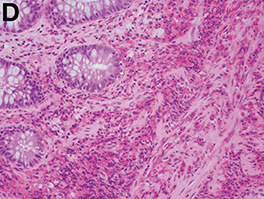
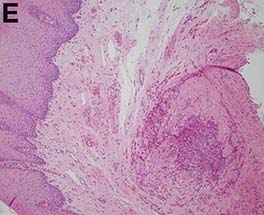
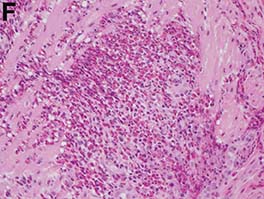
Colonic (Figure D) and esophageal (Figures E and F) mucosal biopsies were obtained, which showed dense eosinophilic infiltrate of the esophageal and rectal submucosa and the rectal deep mucosa. These findings were consistent with eosinophilic gastroenteritis (EGE), mural type. She was empirically treated with 2 doses of ivermectin given the concern for possible underlying parasitic infection given her country of origin, and she was started on oral prednisone 40 mg/d. Eosinophilia and symptoms improved rapidly with this regimen. One month after discharge, her parasitic serology was notable for antifilarial immunoglobulin (Ig) G and IgG4 being positive. At 2-month follow-up, she felt well and denied any abdominal pain or distention with resolution of her peripheral eosinophilia.
The diagnosis of EGE is usually made by endoscopic biopsy showing proliferation of eosinophils in areas of the gastrointestinal tract where eosinophils are uncommon (e.g., esophagus, small bowel).1 It is associated with allergy or atopy, and eosinophil-predominate ascites is a rare presentation of EGE.2 Eosinophilic ascites in the context of postpartum EGE has been described at least twice in case reports.3 It should be noted that eosinophilic infiltration of the gastrointestinal tract may be present in certain conditions, including IgE-mediated food allergies and inflammatory bowel disease. Although certain dietary restrictions can rarely lead to resolution of EGE, systemic steroids are most often used and lead to improved symptomatic response.
Our patient’s positive filarial serology, although not associated with EGE in the literature, is the first known documented association between likely filariasis and EGE. She is presently being further evaluated for active filarial parasitemia and consideration of diethylcarbamazine therapy.
Acknowledgments
The authors thank Dr. Jay Luther for his guidance and manuscript review and Dr. Daniel Pratt for obtaining images.
References
1. Chen, M.J., Chu, C.H., Lin, S.C., et al. Eosinophilic gastroenteritis: clinical experience with 15 patients. World J Gastroenterol. 2003;9:2813-6.
2. Hepburn, I.S., Sridhar, S., Schade, R.R. Eosinophilic ascites, an unusual presentation of eosinophilic gastroenteritis: a case report and review. World J Gastrointest Pathophysiol. 2010;1:166-70.
3. Ogasa, M., Nakamura, Y., Sanai, H., et al. A case of pregnancy associated hypereosinophilia with hyperpermeability symptoms. Gynecol Obstet Invest. 2006;62:14-6.